
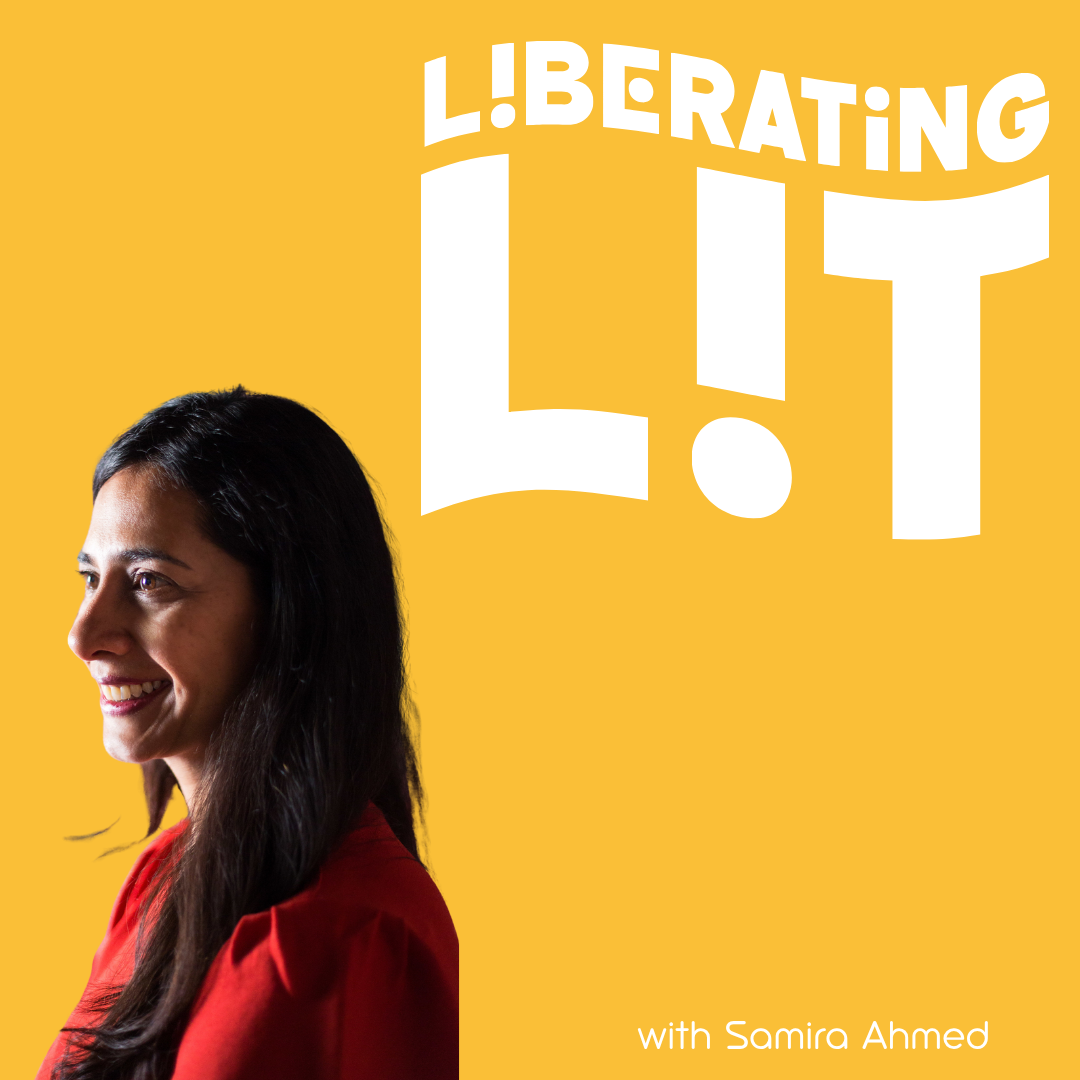
Samira Ahmed is a New York Times Bestselling author and leader within Authors Against Book Bans. In this episode, she goes deep on the importance of curiosity, the power of small actions taken locally, and why one of the most common questions that arises about book bans is ultimately not important.
Show Notes:
Love, Hate, and Other Filters by Samira Ahmed
Internment by Samira Ahmed
This Book Won’t Burn by Samira Ahmed
Kasama bakery
Tinker v. Des Moines
One Day, Everyone Will Have Always Been Against This by Omar El Akkad
Exit West by Mohsin Hamid
Transcript:
Kelly:
Samira Ahmed is a New York Times bestselling author of young adult novels, including Love, Hate and Other Filters, Internment, and This Book Won't Burn. Samira isn't afraid to take on reality in her work, exploring topics such as immigration, racism, and book censorship, something that we know touches upon so many issues related to race, gender, sexuality, class, and more. Before her career as an author, Samira worked as an English teacher, for a nonprofit, and on political campaigns.
Today she's a leader within Authors Against Book Bans, as well as a champion of young people stepping into who they are as they are.
I have known Samira for a long time. Our connection is actually quite funny. In 2015, I served as a judge on a small independent press's book award. It was an award that offered publication to a manuscript deemed the best of the submissions. One of those entries that year was Samira's Love, Hate and Other Filters, a title that our judging team absolutely loved.
When Samira's book was published shortly thereafter by another publisher, she and I struck up a conversation about the story and we've been connected ever since. It's been a joy to watch her career, and it's been so meaningful to connect and collaborate against book censorship. We're neighbors in Chicagoland with a small network here spreading the word about events and opportunities to do good locally. I'm so excited to welcome Samira to the show.
Welcome Samira.
Samira:
I can't believe that was 2015. It's been over 10 years. Wow.
Kelly (02:51)
I am so excited to talk with you and I'm going to start with the most basic question, which can sometimes be the hardest question, and that's tell me who you are and what you do.
Samira (03:00)
So my name is Samir Ahmed. I am an author. I write mostly young adult. I've written some middle grade. I've written poetry and short stories, some for adults. And I've also written some Miss Marvel comics, which was very cool for me to do.
You know, prior to this–I always like to tell people that I didn't even imagine being an author until I was way grown up, like fully an adult. It wasn't like one of those dreams I had as a kid. I always loved writing, but I didn't imagine writing as a profession.
I'm Indian American, so my top three professions, according to my parents, were supposed to be doctor, lawyer, or engineer. None of those worked out, but this one did. Before that I was a high school English teacher. I taught in the Chicagoland area and also New York City public schools. I worked in education nonprofits. I was a deputy field organizer on the Obama campaign. And, you know, I think a lot of my writing work and also sort of my prior to being an author work of being a teacher and an advocate–I think it's really all tied together. You can see how those parts of my life kind of braided together.
As a kid, I didn't really see, I mean, I definitely didn't see any Indian Americans or Muslim Americans in any books that we were reading in school. I'm a Gen Xer, so just to date myself, but there weren't even any really in the library. So for me to be able to now write books with protagonists who share some of the same identity markers as me, ones that many, many tens of thousands of millions of others share is actually quite an honor. I love being able to write for young people. So that's kind of what I do now.
And you know, people are always asking about my hobbies. And I'm like, a lot of my hobbies center around eating, which I for example love pastries. I can talk about pastries all the time. So if you do a whole other pastries podcast, I'm totally there. The next big place I want to try in Chicago is called Bad Butter. I'm very excited about trying this place.
Kelly (05:00)
Okay, I've gotta ask before we dig into this, what's your favorite pastry?
Samira (05:05)
Everyone asked me that. So I will say that in Chicago there's this Filipino bakery called Kasama. It's gonna sound weird, but they have this foie gras croissant that is incredible. It is so good. You have to wait in line. It's worth the wait.
Kelly (05:21)
What was the spark? What got you into advocacy?
Samira (05:24)
So when I was in high school, I grew up in a small town, Batavia, Illinois, which is in the far west suburbs of Chicago. I was the first, I'm pretty sure this is correct, I was the first student of South Asian descent to ever graduate from the high school. And I was the 112th graduating class.
But I remember in a US history class learning about the Tinkers. And they were a brother and sister in the sixties living in Iowa, Des Moines. And during the Vietnam War, they were protesting the war by wearing these black armbands to school. And they were kicked out of school or they were told they couldn't wear them. Anyway, they filed a lawsuit against the school. It went all the way up to the Supreme Court. It's called Tinker v. Des Moines. And it was one of the first times I learned about young people and political activism, I think. And it really inspired me. I mean, so much so that like the following year when our teachers were starting to picket, they were doing informational picketing, like, you know, which is a step that you might do before you potentially go on strike. So it's during contract negotiations. I had the students wear black armbands in support of our teachers.
Is it as big as protesting the Vietnam War? Absolutely not. But you can see the very direct connection for me in learning about the Tinkers and then doing this because I always like to think that with political action or your advocacy work,you're gonna maybe start with small steps. A lot of people are sort of reluctant, but I always think like there's these gateway drugs to advocacy. And that drug might be just a small thing. Like it's me in high school, like I'm not old enough to vote yet, but I can express my opinion by wearing this armband. I was the editor of the school newspaper and so I wrote this op-ed about the failures of the administration to really understand the student body. They published it, so I was like, Okay, I mean, it taught me about having a voice and using whatever platform you have to speak. So I think those are sort of my very earliest experiences with being like an activist in any way.
Kelly (07:33)
Can you talk a bit about your background in working on political campaigns and where and how that has influenced your engagement with advocacy? Maybe, too, where and how you think that background and experience impacts how you think about your writing and storytelling.
Samira (07:48)
So I talked a little bit about my high school experience. And then when I got into college, I went to University of Chicago. So I was participating in more sort of on campus protests. Like when Orrin Hatch came to speak at the law school, I was part of this protest of people holding up signs or like against Adolfo Calero with the Contras in Nicaragua, long story. People can look that up on their own. I was in a protest for that.
I was sort of starting to get a greater awareness of what I could do and how I could act. I know this sounds so naive when I say this, but I still actually believe it. And I think that it's our duty as human beings to try to make the world better. The world starts in your community. It starts like on your campus. It starts in the most local way possible, maybe even on your block.
And so then after that I started doing sort of more volunteer work during, you know, presidential campaigns, just like calling other voters. I was in my teachers' union and we actually went on strike. So I learned a lot about union organizing and community organizing that way. And also I was a poll watcher where I was going to the polls and just literally watching and recording what people were doing. I did door knocking for local school board candidates when I was a union member.
One of the things I always tell people is voting for your local school board is one of the most important things you can do. And people I think don't honestly believe me when I'm saying how important it is, but that's literally your local tax dollars at work. And so few people vote in school board elections. It is maddening to me. Because they're controlling what happens in your schools with your taxpayer dollars. And everyone should be voting in that election. It's like the easiest election to vote in. And so many of those elections can be decided by literally five votes. So that was like one of the earliest things I did.
Then I started doing more like volunteer work for presidential campaigns and phone banking. And that's when we got to do phone banking in person, which was kind of nice. I mean, I know now there's a lot of phone banking on Zoom, which makes it much more accessible, which I think is great. I did phone banking for John Kerry, get out the vote calls, like even on the day of the election. And what I loved about that was just talking to people. I did a lot of mine for voters in Ohio, and that was also when I started learning about how difficult voting can be in some places. I was living in Chicago and New York City at the time when I started doing more phone banking. Both of those cities are very blue cities. It's not really an issue of who's gonna win. I mean, in Chicago, we don't–I guess we've had Republican candidates run for mayor, but I can't even remember their names really. Everyone just runs as a Democrat, and you're either a right wing Democrat or a more progressive Democrat. So I started doing a lot of phone banking, and then during the Obama campaign, I did like the full training because I was like, Okay, I'll start with phone banking and then I'll start with I'll do voter registration and then I'm gonna do door knocking, and then I was like, I'm gonna go full in on this. I became a deputy field organizer, which means I worked full time but for free in Pennsylvania.
So I lived there with this nice sort of like retired couple who had an extra room and that's how the volunteers, you know, when we were coming in from out of state, that's how we were living in those areas. And we did win Pennsylvania in 08, and we had turned it from red to blue. So I learned so much from that campaign. Campaigning for Obama, one of the things you realize is that it's all telling a story. The candidate who tells the best story is gonna win unless there's voter fraud or attempts to overturn the election. But folks who were alive during the ‘08 Obama campaign know the story. Like you know what his background is. And he's obviously an incredibly compelling public speaker. But when I was training volunteers, I was basically training them in storytelling too. Like we would knock on doors and ask people, have you registered to vote? Do you know who you're gonna vote for? And can I tell you a little bit about this person? You have to tell it as a story, because no one wants to sit there and listen to you go through a bullet point list of just plain old facts. That's boring. You need to somehow connect the candidate to the voter. That's telling a story right there.
I always was a person who loved telling stories and loved talking. And so I think it helped me understand number one, the power of story, and number two, how much story is just present in every single day of our lives in the way we communicate to each other.
I would tell my students, especially if we were writing personal narratives or even like narrative, nonfiction or even fiction, I would talk to them a lot about how it's about everyday life. Like if someone says like, how are you doing or what did you do this weekend? Okay. I could give you a list. Like Kelly, I could be like, you want to know what I did this weekend? Well, I woke up and then I brushed my teeth. I used a toothbrush and I had toothpaste. After I did that, I decided to lie on my couch for like 20 or 30 minutes and just doom scroll for a while. No, you're not going to because this is already boring. You're already asleep, Kelly. I'm gonna pick the things in my weekend that were the most interesting to me because those are likely gonna be the most interesting to you. That's me telling a story to you and engaging you. And then maybe you're gonna find something in that story where you're gonna be like, you went to the Printers Row Book Fair, I was there on Sunday and I saw this author, and I'm gonna be like, I don't know that author. And you're gonna be like, you should read this book. It's so great.
So those conversations, that dialogue to me is also so much a part of my writing because I believe in my writing, I mean, obviously I'm writing stories, but I'm also in dialogue. I'm having a conversation between me and the reader. Now, of course, I'm not having a conversation directly with every single reader, but it is still a dialogue where I'm sharing the story, I'm writing the story.
And when the reader reacts to the story, whether it's by an emotional reaction, whether it's by something else, they say to another reader, that is all of us engaging in a conversation. And to me, conversation is what connects us. Like those stories connect us to each other, and it helps us understand how much alike we are. And so that goes way back to my corny belief that it's our job to make the world better. And I think as an adult, this is something that I take very seriously. That's why I love writing YA. I think it is the obligation of every single adult to protect, care for, and love children. And that is like our most sacred duty as adults on Earth.
I can't go out and physically protect every child. I can't, none of us can do that. But we can show kids that they are seen and loved and that their stories can be known. And I think that is so important and that's foundational to all of my work, whether it's in book bans or in writing novels.
Kelly (15:08)
That was a fantastic answer. I'm gonna roll right into the next question because I suspect you'll have a really great answer for this one, too. And that question is, who do you learn from?
Samira (15:18)
I learn from every person that I meet. I actually love as a former high school English teacher and now as a YA author, I love learning from kids and young people. Sometimes what I learn is stuff I don't want to know. Sometimes I'm like, you know what? I don't wanna know. I don't want to know about looks maxxing, guys. I could live without knowing who Clavicular is. Like, that's fine. ButI also love just listening to young people and hearing what they have to say about their world, whether their world is their classroom, their school, their actual home, their community, because it gives me a sense of the world that we are creating. And so I'm always learning from them because I have always believed that curiosity is more important than passion.
I know a lot of people say like what they're writing, writing is my passion. I turn my passion into a profession. And I think passion can die. Like I think passion can be short-lived. Like, I mean, ask people who've gotten divorced. When you meet someone and there's that first like compelling crush, and that's like what you get to write about in YA love stories, right? The butterflies. I think that's the same as it is, you know, when I think about the early stages of a story or a hobby that I really love or just something that I'm learning that's really cool.
But I want to maintain that and you maintain that through curiosity. Like when you can ask questions, when you can say to yourself, let me see this through someone else's eyes, let me see this through a young person's eyes. You know, I really love hearing three year olds or four year olds talk, like speaking to each other, because they don't have the language that we have. They just don't have as many words. I love listening to how they try to get around that.
So for example, my neighbor, who's three, came over to my house. We had a barbecue. There was a pregnant woman there. And he went up to her and she was very visibly pregnant. Okay. And he comes up to her and goes,” What do you have in your house?” And she was like, “My house?” And he points to her belly and says “Yeah, in your house. What's in your house?” There was something so adorable here because I actually love this metaphor of providing shelter for this human being that you're bringing into this earth. And this little kid was not sure how you should ask this question. So he asked her in this way. I was like, should I use that as dialogue? And next time there's a three-year-old in one of my books? Probably yes.
But I learn from everyone's individual worldview. I think one thing that adults need to be better at is listening to young people and what they're saying, because they're observing the world in a different way than we are. I think we can learn from each other.
You know, I have to say, I'm gonna amend that. I don't learn from everyone. Like what I learned from fascists in power right now is not something that I want to take in as a valuable lesson. What I'm learning is that they are driven by hate and it seems like they have so much fuel for that hate. I hope that we who are trying to oppose this can lead with love. Like we love our young people, and that's what makes us do the work even when it's exhausting.
Kelly (18:40)
A great answer, and I especially was taken with your insight into curiosity versus passion. I suppose part of that is because it is a thing that I hadn't quite put together before. As somebody who constantly feels like I've lost my passion for something and yet continues to have the drive to do things and to try things and to explore things, and who also really resonates with curiosity as a core value, I had never put those two things next to each other. Yet you put them together and now I'm having this whole mind boggling moment–like suddenly it makes much more sense.
Samira (19:16)
So much.
I mean, it was like when you came to me about this podcast. You have been in the thick of book bans and censorship and reporting on all these things that are happening in libraries for so long. And I'm like, that girl's gotta be burned out, and yet now she's starting a whole new podcast about talking about these things. But that's exactly why you're doing it, because even if you're like, I've been steeped in this and my god, I'm sick of these people, you're also like, I'm still curious about what other people are saying. I'm bringing people together because we need to have a bigger conversation. We need to continue to have these big conversations. So I love it.
Kelly (19:52)
That, and also like one of the things that I really think about a lot is how important a historical record of this moment is. Literally that is what I've been doing by collecting these links every single week for six years now. But I wanted to expand what that historical record looks like and really give people who have been doing incredible work through this time period and beyond this time period the opportunity to share why they do it, how they do it, what inspires them. Because I think the more you hear from a wide variety of people, the easier it is for folks who are either curious about the work but haven't gotten engaged or have been engaged for a long time or are feeling that sort of burnout, like you have more opportunities to be re-inspired and to find ways in.
When we talk about the idea of advocacy, it can feel really overwhelming. And yet advocacy is as simple as what you said: voting in your school board elections, caring enough to put people in these positions in your backyard who care about the role, who care about the institution. Like that is a small thing and yet it is not a small thing at all.
Samira (21:00)
Yeah, I mean I think that we could also have a whole podcast episode just on school boards. But voting in your school board and going to even one school board meeting, that is advocacy. You are an activist by doing that. And you're also witnessing history. So I really love that you're talking about how you want to collect this for history, too, because I think as Americans, we are terrible at understanding history. And we are also not great at making connections. Like so much of the way we learn history is in a silo.
Part of the work that I'm doing with Authors Against Book Bans and why I wrote This Book Won’t Burn and, you know, everything else that we are all collectively doing is because I want people to understand that when fascists first come into power, when we see tyranny rising, like historically, some of the very first things they go for are books and art. And they attack those freedoms. They try to crush them.
I think it's for a few reasons. One, it goes back to the thing I said earlier, which is they don't want us to have our joy. Fascism is a joyless place, and fascists are deeply uncurious people. Knowing how much curiosity means to me, when I call you deeply uncurious, that's like one of the biggest insults I can send your way. They also want us to be uninformed because an ignorant populace is easier to control. And so I mean, I feel like I'm constantly on the soapbox where I'm like, guys, The Nazis in 1933, what did they go after first? Books. They had literal bonfires burning books. And then during World War Two, when it was so hard, when you were literally risking your life to advocate for just other human beings to try to advocate for our basic freedoms, there were still people doing it.
Kelly (22:43)
So since you referenced this in that answer, I'm gonna go ahead and ask this question, which is where and how have you explored literary advocacy in your work? Obviously, This Book Won’t Burn comes up here. Where have you seen your work connect with young readers who are either already engaged in advocacy and or are looking for a way in?
Samira (23:03)
I would say there's advocacy in all of my books, even books where it's maybe a more romance forward book. Because, you know, I write mostly contemporary or slightly dystopian or slightly speculative novels. I consider everything I write contemporary, unless it's actually historical fiction. Because the dystopians feel contemporary now, too.
But I say that I like to write the world as it is, so we can imagine the world as it could be. Because in all of my books, young people are imagining a world better than the one they're living in, and they're all actively trying to contribute to that in some way. In so many ways, it can be just very tiny ways. Sometimes it can even just be like a rejection of a stereotype or microaggressions or whatever that people are putting on you. That requires a tremendous amount of confidence and belief in yourself.
I think it is so important for young people to have that and for adults to have that, too. I think that so much of our fear of not wanting to speak up and not wanting to act, not wanting to draw attention to ourselves is because we don't have enough sort of internal belief in who we are and the rightness of the struggle, right? But I would say that, you know, more specifically in Internment and Hollow Fires and This Book Won’t Burn, you see young people advocating or engaged in political activism in different ways. So in This Book Won't Burn, which is about censorship, we have kids actively fighting book bans in their school. That was really based on stories that I heard from teachers and young people when I was visiting schools. And it's amazing what young people are doing. Through Authors Against Book Bans, I've gotten to meet a lot of local advocates, people in their communities who are pushing back against book bans and you see how young people are absolutely a part of that, like in Florida and in Texas and in Tennessee and Virginia and North Carolina and Pennsylvania. It's really amazing to see what young people are doing.
In Hollow Fires, I have a student journalist who is basically trying to solve this murder. And she's pushing back against the sort of police who aren't interested in solving crimes that are committed against Brown or Black people.
In Internment, we have a young woman who's literally fighting for survival because her family has been put in an internment camp because they're Muslim.
So I'm gonna tell two stories about students and reading my books. For one, I did a panel with a teacher and some of her students, and they had read Internment and they were trying to figure out like at the end of that book, the project the teacher asked them to do was to make a change. How are they gonna make some positive change that they can do? And in Internment, this is a young woman whose family have been put into internment camps from Muslim Americans. It's like 15 minutes in the future. It's obviously a parallel to what happened to Japanese Americans and their illegal incarceration in the United States during World War II. But it also came at a time when Trump had the Muslim ban in place, where he had talked about trying to create lists of Muslims, and why they wanted to change census questions. And so this class, they read it, and one of the things that they decided they wanted to try to change was in their school–they didn't have recycling. Is it fighting for your life in an internment camp? No, but I'm glad that no kid is having to do that right then. What they did was they didn't have recycling and they were like, we should have recycling. Seems like it's easy enough. But then what they had to do was put together a proposal, they met with their principal, they met with their school board, they figured out how to get funding for the recycling bins in every classroom and they put together this whole proposal. Now, they have recycling in their classrooms. I freaking love this.
You know, and they were like, well, we know it's small. I was like, no, this is you doing a ton of work. Yep. And creating a change. Young people who don't even get to vote in a school board election. Like, how amazing is that?
For This Book Won’t Burn, one thing that I've heard–a few different schools have done this, and I actually got to meet one of the students who did this–after they read the book, in This Book Won’t Burn, there are small, like they're not actually Little Free Libraries because that is a trademarked term, but they are little they are small libraries, sharing libraries where people would put books and in. In This Book Won’t Burn, the kids work to try to get banned books into those libraries that people can take because certain books have been banned at their school and they want to put them in these libraries. They work with local booksellers and other concerned adults to get those books in there. This young woman I met, she started that in her community. She started after she read the book, and her class project was to start a Little Free Library.
After they read the book, I saw the teacher at an English teacher conference, and that young woman was with her. She is in a teacher training program, and she's kept up the library. I mean, I love that so much. It's just and again, it's like one person doing this individual thing, which maybe doesn't seem you know, maybe it's not like having an entire march on Washington, but that is making a change in her community, and now she's gonna be a teacher.
Like how cool is that?
Kelly (28:29)
I think we sometimes get caught up in this idea of big versus small, right? Like when somebody does something to create a change, like I think we spend a lot of time thinking it's not big enough or not strong enough. But any change you make is a big change because it requires work. It requires time and energy and thought and action.
What keeps you going?
Samira (28:57)
There are 100% times where I feel down, where I feel tired, where I feel kind of exhausted. And I know I sound like I'm a person with a lot of energy. I mean I am generally speaking, but sometimes that is depleted. And I have to be honest, sometimes I'm not great about filling the well. I have been on a little bit of a social media break, which I have to say has been kind of awesome.
But also, you know, I love reading, obviously. I also love talking to people and I am one of those annoying people from the Midwest that will just randomly talk to you. I just really feel like having a connection to other human beings, even strangers–I sound like really a Pollyanna now, don't I–I feel like that is important and it just reminds me that I don't live in a bubble and that I need to work with my neighbors and and strangers to try to make things a little bit better.
In Chicago there's been a lot of ICE presence early on, you know, before all the terrible stuff that happened in Minnesota, and I was really happy just to see neighbors helping each other. You know, small things like my local indie bookstore distributing whistles. That's call and response Chicago. They were distributing whistles and information packets about what to do if you witness ICE. There are so many local churches and we're doing just these small things and I just know that's really important.
Last night I actually went to a fundraiser for the Chicago Human Rhythm Project, which is about dance and drumming. It specifically began with tap and there were Irish dancers and there were tap dancers and there were flamenco dancers. And it was just a fundraiser for this Southside dance project. It made me feel so good just to be there and like, you know, it's funny 'cause I'm not a dancer like at all, but when I was watching these dances, I was thinking, like, yeah, this is also a story. Like, it's also a way of communicating. I don't know, I think when you can just look out in the world–and this goes back to that curiosity thing–and just see how many totally amazing, cool people there are out there, like it makes you feel less alone.
I think that maybe that's my point in this long winded answer, which is activism can also feel lonely. It can so often feel like God, I'm the only one. I'm like doom scrolling on this thing and like, God, why do I have to read this? Why is this being put into my eyes? Why is Mitch McConnell on my mind? Like, why does this have to happen? And it feels so terrible. But like when you can, I don't know, just talk to people, engage in any way, it just reminds me that I'm not alone. And I think community can save us.
That is like for me, it's a community of authors. It's the people that I work with in Authors Against Book Bans. It is my actual community that I physically live in. It's me going to my indie bookstore and just chatting with the bookseller sometimes about books or whatever. It's me going to like the grocery store and like when I don't know, this just happened the other day: I was at the grocery store and the person who was scanning my groceries was looking a little down. They are like, How are you doing? And I'm like, okay, and how are you? Are you okay? And then they related something that had happened that they were kind of down about. And you know what? I don't know. It was just a tiny small interaction that at the end of the day was like one minute of my time. But maybe it's nice for someone just to ask you how you're doing and then listen to you. And again, I really sound like a Pollyanna in this, but I just believe that community is what will save us because acting in community is so important, especially in the time that we're living.
Kelly (32:55)
You touched on this a little bit in that answer, and I think it also ties back to the very first thing you brought up. So I'm going to ask this question, which is what kind of self care do you practice?
Samira (33:05)
So I do a few things. So God– this is gonna sound like I really am big on deep breathing–I am trying to incorporate this into my daily life, which is I begin the day with five minutes of diaphragmatic breathing, which is basically you know, for people who do yoga, you are familiar with deep breathing. Honestly it brings cortisol levels down and it sort of equips me for the day.
I also write in a journal, and I've been writing in journals since I was very young. I don't necessarily do it every single day, but I do it quite frequently, which I love.
I also have been doing this thing since COVID, which is that I have an acupressure mat. Do you know what this is? I think R.O. Kwan talked about it on Twitter and I was like, I'm also gonna get this acupressure mat. It's basically just like this small padded mat that's like, I don't know, half the size of a yoga mat. And it has these discs that have like these plastic pointy things on them. And there's also a neck roll and you can lie on it and essentially it can hurt a little bit in the beginning, but it's basically acupressure for your back and for your neck. I do that like every night before I go to bed because I'm a bad sleeper and I found that that helps me sleep. I don't know, those are very tiny self-care things, but they really help me a lot.
I also like to go on walks. I also like to listen to audiobooks a lot.
Kelly (34:58)
I think we think they're small, but they make such a big difference. And you know, if it's something that helps you, then small is all you need sometimes, right?
Samira (35:07)
Yeah, it's like 10 minutes a day. And you know, we all have 10 minutes a day. Even moms and I'm saying moms, but it can be parents. 'Cause you are really having multiple jobs, right? Everyone has multiple jobs in this economy and like all of these other things, but you've got to find like 10 minutes a day for yourself.
I mean another big thing that I do is I have herbal tea and sit alone in my office or my back porch doing nothing else. It's literally a five minute activity and honestly I really enjoy that.
Kelly (35:38)
It's grounding. You have to reconnect with yourself and ground and just be present with what is.
You're part of Authors Against Book Bans, which is an organization dedicated to liberating literature from censorship. It's a huge organization, and I would love to hear from your perspective about the community and coalition building that have helped provide the structure and support for the work AABB does.
Samira (36:02)
Yes, so Authors Against Book Bans, there about 5,000 of us and we are authors of all different kinds of authors. I's not just kid lit. It is authors writing for every age group, in every genre. It is poets, and it is illustrators too. It is for nonfiction writers, and if you are in education writing, you could also be members. So this is just my pitch that if you are a published author, like if you're an essayist, if you're an anthologist, whatever you are, please join us because there is power in numbers. We have about 30 different regional chapters. And a lot of our focus, yes, has been on the district level and the county and state levels. That's why we work with authors who are in those areas who partner with, you know, for example, freedom to read organizations in Florida or Texas or different like anti-censorship coalitions locally.
Again, this goes back to why it's important to vote in your school board–working locally with other grassroots organizers to push back against school boards, to show up at school board meetings because that's where those district level decisions are being made. To do lobby days at your state legislature. You know, we're trying to push back in every way that we can. We are trying to work with local authors and other coalitions to get freedom to read legislation in different states. Like Illinois does have a freedom to read bill. It's not exactly what I want it to be, but it was the first and it was a good first step. And you know, we have bills in Rhode Island. We have something that's coming up in Massachusetts, Maryland, Colorado. Sorry if I'm missing your state. Other states also work together, and coalition building is really, really important because remember how earlier I said sometimes it can feel like you're alone? Even Authors Against Book Bans, we are a group of 5,000 authors, but still, we don't want to be doing this work alone.
We know just statistically that the vast majority of Americans are against censorship. And yet right now we have this completely bananas fever pitch of like book bans. There are four federal bills potentially that could create national book banning laws. They are specifically focused on things that they refer to as gender ideology and political ideology. So if there are any books about queer or trans characters or by queer or trans authors. If there's a book with like just two boys kissing, holding hands, that can be considered gender ideology. If there's the existence of a trans character, the mere existence of someone who uses they/them pronouns in your book: if that book is in the school, that school could potentially lose federal funding.
Equity ideology is speaking to basically civics, history. We already know that this administration is trying to whitewash history. We see how they have reacted to things like the Smithsonian, what they have done with the National Park Service. So there's these four bills, and we're trying very hard to rally all of our members to call their reps and their senators and tell them they want them to very, very vocally oppose them.
This is interesting because we still are having to fight the district level fights and the state fights, but now we see that there's a lot of money on the right for that hate. And we see them trying to push this on a national level. And even if we say like, the Senate bill can't get to 60 votes to pass it, I don't wanna rest on that like hope. This is one easy way to engage your activism and to be an advocate, which is to make a two minute call. Or even, you know, sometimes people don't like making calls. We work with EveryLibrary, and they have a system where you can email. We have many partners both nationally and on the ground that are also doing this work. And so it's important for us to join forces.
So, you know, that goes back to I guess when I talked about my work in the Obama campaign and other campaigns. The more of us there are, the more power we have. And even if you're not an author and can't join Authors Against Book Bans, I assure you that in your state, wherever you're listening to this, there are groups that are working on the freedom to read that are pushing back against censorship. And at the very least, you should be getting Kelly's newsletter because you have documented this more than anyone else. You have the most robust documentation of what is happening across the country, these various bans.
People, I think, don't understand. Like I'll say numbers like, nearly 25,000 books have been challenged and and are banned in the last several years. And people will look at me and be like, what? Because they have this assumption that somehow it's only like books, like that there's somehow the VC Andrews books have somehow made it into a kindergarten library and that book is being banned. That book's not in a kindergarten library because guess what? There's actual professionals like teachers and librarians who are creating the stacks in that school library and in and creating the classroom library. They're picking appropriate books for your kid at the grade level that they can be reading.
And then I'll say something to people like, well, Charlotte's Web is a book that's banned. And they're like, What? Charlotte's Webb? I'd be like, yeah, remember that book you read in fourth grade? Yep. They're like, why? And I get this question a lot: why? And I wanna put it out there, maybe it's an unpopular opinion: the why doesn't matter. To me, the why is because of assholery, it is about racism and homophobia and transphobia and fascism and you know wanting to perpetuate ignorance. That's the why. So if you need a why, I've given you all the whys, okay? That's not the question I want us to be asking.
I want us to be asking and then answering the question, okay, and now what? This has happened. What are we gonna do to fight about it? Like, and what's our action plan?
The why isn't what we care about anymore. It's done. What do we do now? And what can I personally do about it? Because guess what? You can personally do something about it. I want to just put this out there. I say this a lot, and I say this at pretty much every place I speak. And like I've probably written this down many times, but I am a believer that you need to use your power and privilege for a purpose.
It is so often that those who have the most power and the most privilege are afraid to act or don't act. They are sheltered by that privilege that they have. And what I'm asking everyone who's listening, I'm every author, every reader, everyone is to think about how you can use the power and privilege you have for a purpose. And like when I said earlier, I believe that one of our greatest responsibilities as adults on this Earth is to help young people. This is a way you can help young people.
I always like to roll out, like, remember how I talk about the gateway drugs to activism? I like to give people this little rollout. I'm like, okay, let's start with this: are you registered for this next election? There's an election coming up in Chicago for a school board. Are you registered for it? Okay, you're registered? Awesome. Can you ask like two or three of your neighbors if they're registered to vote? It's literally just a question. When you go to your book club, I have a book club, I mean, they're probably like, wow god, she's talking again. But they're like, you know, I'm like, have we all registered to vote? Do we know who we're gonna vote for a school board? How do you register to vote? Can you register two of your friends to vote? Can you show up to vote? These are small acts that you can do. They don't take a lot of time.
Show up to vote. I guarantee you that for your school board election, there is not going to be a line out the door like there is for presidential elections, okay? Register, show up, vote. That is like my big thing for locals. This is what everyone can do.
Everyone who's listening to this likely has the power and privilege to register and to show up to vote. That's the first step I'm asking every single person to do. I also want every single person who hears me to get a library card. Again, this seems like a very tiny thing. Sometimes people will ask me, and I'm like, does everyone here have a library card? And then they're like, why are you asking that? I'm like, you know what? Because you getting a library card is showing the importance of that library in your local community. It's showing that this library is serving your community. Because libraries, as you are reporting, are losing funding in just maddening ways.
I just listed like two or three tiny things that you could do that are going to take 10 minutes of your time. All of us can do that. And then if you have more power and privilege, and that includes time, do you have the time to do this and the capacity to do this? Do you have the accessibility to do this? Can you use being white to help you in some of these situations?
I'm Asian, I'm South Asian, and I still know that my race accords me a privilege that not every not every person of color has. I’ve got to try to use it wherever I can, and so I'm asking my other allies and especially white allies, what are things that you can do? Because you have more protection than most of us. And that doesn't mean that you aren't also facing a ton of shit. It just means that you're facing a ton of shit, probably not based on your race. So let's go, people.
I talked to a lobbyist. This was someone who worked in the Obama administration. And one thing they told me was that if on a certain topic or bill or piece of legislation, a Senator or Representative's office gets 12 calls that day–12 calls in one day–it bumps it up higher into the queue of things that they should be paying attention to. 12 calls.
Like me and you, that's two right there, if we had the same senator, which we do. We have two of the same senators. We both call Durbin's office, although Durbin doesn't answer his calls. Tammy Duckworth's office does. We need 10 more friends. Can we get 10 friends to call? We probably can. These are small lifts. And one thing I like to remind people, because I know it's not always easy for people to make a phone call, that there are contact forms, there are ways to email, and they do log that.
But I also just want to reiterate to people that everyone in government works for us. We employ our representative and our senator and also our president. They are public servants and we are the public. So it doesn't mean that I'm disrespectful when I call, but that is my mindset when I'm calling. Like this person is not doing the job that I want them to do and that I am paying them to do. People, you have more power than you think you do. So use it. Why wouldn't you?
I was like Thor and I had my hammer, I gotta use my hammer. And right now I'm just you know, I'm just a citizen, so I gotta use the hammers that the Constitution, such as it is right now, has given me.
Kelly (47:07)
So my last question for you is this one. Because this is a podcast about liberating literature, and I use the word liberating in all senses of the word, I end each conversation the same way: by bringing it back to books. Can you talk about a book that's been influential in your life? And this can be a book that inspires you or it's a story that's just stuck with you for some reason.
Samira (47:27)
One Day, Everyone Will Have Always Been Against This. It's a collection of essays about his experience as a Palestinian and what's happening in Gaza. And it really started with him tweeting about it. And it's like so moving and very deeply disturbing, and you know, all the things. The other book that I recommend a lot is by Mohsin Hamid. It's called Exit West. I really love that book. It's a book about refugees, but there's a magical realism element to it, which is because it starts in a country that's sort of war torn. It's loosely based on Pakistan. And there's refugees leaving. But the way they leave is not on boats, but through stepping through these doorways that sort of magically transport them to some other place–they don't know where. They end up in refugee camps in whatever country it dumps them into. And it really asks all these questions about notions of home and I don't think we think enough about why would you leave your home. You know, you only leave your home if it is too freaking horrible for you to stay.
I guess both of those books are in some ways about that. I think both of them raise really important questions. Like in the US, I feel like we're too isolationist. And I just really encourage us to read and read broadly and across genres. And I don't know, reading just–I feel like when you read it opens your mind, it has you asking those questions, it inspires your curiosity, and you know that's like one of the most important things to me.
Kelly (49:06)
Samira, thank you so much for joining me on this episode.
Samira (49:10)
Thank you so much, Kelly. Thanks for doing this podcast.
