
Episode Four: Marley Dias
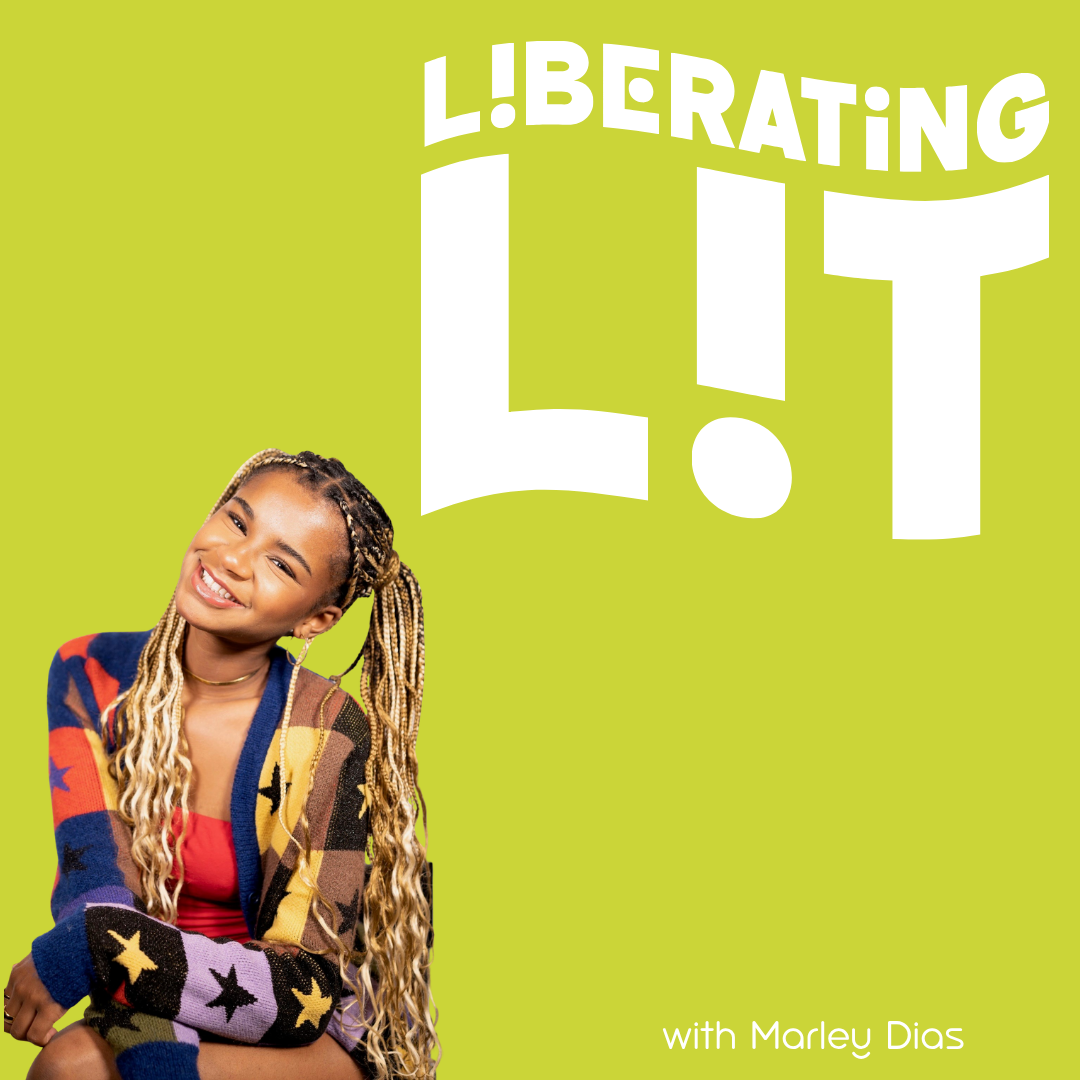
On this episode of Liberating Lit, Marley Dias talks about being a young literary advocate, growing in her work from 1,000 Black Girl books, and the power of sharing your message and passion with young people.
Show Notes:
Marley Gets It Done and So Can You by Marley Dias
I Am the Dream Come True by Marley Dias
The Librarians documentary
The Autobiography of Malcolm X
Transcript
Kelly Jensen/Liberating Lit (00:01)
The year is 2015. A sixth grader complains to her mom that the only books they're reading in school are about white boys and dogs. She, a young Black girl, wanted to see more in books being read at school, and she wanted more choice in reading stories that showcased people who looked like her. That's when she had an idea. Marley Diaz launched the campaign in November of that year called 1000 Black Girl Books.
The goal, as the hashtag suggests, was to collect 1,000 books with Black female leads to donate to schools nationwide. This would raise awareness of the amazing array of books that have Black female protagonists, and it would help bring those books to schools where young people would have access to far more diverse literature. Diaz didn't just achieve her goal of a thousand books, she collected over 9,000 titles. In the 11 years since that campaign, Diaz has been doing tremendous work in the book world.
She published her first book in 2018, Marley Gets It Done and So Can You, which encourages young people to get involved in advocacy, volunteering, and social justice. The book not only supports young people in getting involved in their communities, it's also a book that supports their interests in literacy and reading. Her second book, I Am the Dream Come True, published in the middle of 2026, is a personal picture book about her family and where her ancestors have been crucial in helping her, her parents, and others in their lineage to make change in the world.
Collecting 9,000 Black girl books and writing two books before graduating college, which she did this spring, is impressive enough. But Marley, as you might imagine, has done so much more. She's edited the online zine called Marley Mag for Elle Magazine, has been the ambassador for the National Education Association's Read Across America program since 2021, and hosted the 2020 Netflix show called Bookmarks: Celebrating Black Voices.
I think about Marley and her work a lot. When she launched 1000 Black Girl Books, I asked my own networks to help donate cash so that I could send one giant donation to the project. And now whenever I peruse Amazon and I see a purchased in 2015 note on the landing page, I can almost always guarantee that it was for Marley's project. To say I'm honored she's here to talk is an understatement, but I'm honored and cannot wait to learn even more from such an intelligent, creative and passionate person. Thank you so much for being here, Marley.
Marley Dias (02:30)
Thank you. I’m so happy to be here.
Kelly Jensen/Liberating Lit (02:32)
Can you tell me a little bit about who you are and what you do?
Marley Dias (02:35)
Well, first of all, thank you for your support to my campaign. I really appreciate it. As you said, it began in 2015, but it really started to blow up in 2016. So to know that you were an early supporter is also really awesome. A lot of people got in later down the line.
So I was a ten year old girl, voracious reader, and really I knew that so much of why I felt confident about myself was because of my mom's Jamaican heritage and her teaching me about the amazing Jamaican women and people that have contributed so much to global culture, activism, and Black rights movements. With that understanding, I really always felt confident in who I was and the ways that I could show up in an academic setting.
I noticed that other Black girls in my class didn't feel that way. And the big thing that was different were the books that we were reading. I read so much outside of school, I had access to so much more information about my experiences and my culture, and so many other young Black girls didn't have that. So it became really important to me once I noticed that difference to do something about it. Because the issue was school curriculums and assigned reading lists were not refreshing themselves and making consideration for the diversity of their classrooms. So turning that into a digital movement meant a 10-year-old posting on her mom's Facebook, asking people to donate books,
I was doing that for a while until I was on the Ellen show in 2016, which really exposed me to so many more educators, publishing houses, and created a kind of public call to address what was happening with Black girls and Black stories in children's literature. It's because reading is my passion and because it's something that is so fundamental to every part of life. I've never shied away from continuing to do this work even after we passed 1,000 books. So now we are at 15,000 books collected. And we still collect books, but it's not the kind of primary function of what I do as a person anymore. I don't sit and count books all day anymore. It's been a really fun experience to get to write my own and then bring that story into it and provide kids with titles that teach them about Black girls or teach them about themselves.
Kelly Jensen/Liberating Lit (04:42)
What was the spark? What got you into advocacy?
Marley Dias (04:46)
I think my mom kind of got me into advocacy when I was five years old. She started a foundation called the Grassroots Community Foundation, which is a nonprofit focused on creating a world where all girls grow up to be healthy women. And for me, watching her start a nonprofit out of our kitchen table and be able to bring so much support to Black women and girls across Essex County, New Jersey, where I'm from, and later expanding that to Philadelphia, to Ghana, Jamaica, and South Africa, I always just felt like, okay, if this lady can put things into motion, why can't I?
I think she just inspired me to take it all the way there because I had seen her kind of lay the groundwork so coming up with an idea, executing it, and then creating a community around Black justice and telling our stories.
Kelly Jensen/Liberating Lit (05:47)
You touched on this with that answer, but I'm gonna ask it a little bit more straightforwardly, which is that your parents are fierce literary advocates in their own right, and you've been supported by them since you were really young. Can you talk a bit about where and how they fostered a passion of reading and f books for you since your youngest years? And maybe what is your earliest bookish memory with your parents?
Marley Dias (06:08)
Well, first I will say that my parents are extremely nerdy and also were extremely poor when I was born. They were living off of fifteen thousand dollars. My mom was in grad school and my dad was unemployed at the time, I believe, and living in Philadelphia at the time.So it was like anyone that comes in here is gonna sit and read to Marley. We can take your used books, we can take your old books. Books are something that no matter your class or status, it's something that you can find access to and are a really important and fundamental part of development. So they took that as their main call for people to give gifts to me as a young person or as a baby.
So anyone that would come into my childhood home had to read to me like when I was under two and I learned to read when I was about like one and a half, like super young, because I had spent all that time with all these books. My parents would find books anywhere and they would bring them into the house and read them to me. It would literally be like a Danish instruction manual. Like they didn't care what it was. It's getting me to read, and I think for them knowing that the quicker I could express myself, the quicker I could tell them who I was, the more they would understand me. They saw reading as the gateway to doing that.
Kelly Jensen/Liberating Lit (07:27)
That is incredible, and it reminds me of a conversation I had with another guest on the show about being in the parental role and giving books to young people and watching them turn into readers and discover what they love to read and discover this passion for literature and storytelling. Hearing it from the young person who had that exposure is, I think, really powerful. And it's a reminder of just what can happen when the adults in any young person's life prioritize reading and books and access to these things, even if it's a Danish phone book, right? It is something tangible, and it is something that shows importance and value in writing and storytelling.
Marley Dias (08:14)
Yeah, it's really important to kind of give kids the chance to see that like the experiences you're having now, the life you're living now. It matters and it becomes a part of you. I think doing activism and being an activist so young–I know I'm no Angela Davis, I know I'm no, you know, whomever, but it's to show kids your lived experiences, the communities you're around, and the systems you engage with. They matter and they affect you and shape you into the person that you are.
Through having the community that I had and being able to tell my mom I'm sick and tired of reading about white boys and their dogs, it was really her asking, what are you gonna do about it? instead of suggesting that the conditions that children live in cannot be changed by their community or by the children themselves. So whenever I go to schools, I tell kids if you don't like your lunch food, you can make a petition. If you wanna change your dress code,you can have all the boys wear skirts and all the girls wear suits. If you want to do these things, so much of the social infrastructure around us is flexible if we come together to change it. Books kind of show us that.
And then I think in my experience in my campaign I've always tried to at least open the door for other kids to be more imaginative in the ways they show up in the world. And really Marley Dias Gets It Done and So Can You is the toolkit that was specifically made for this.
So much of it is about not just activism, but my self expression, my education, and just how I learned to move about the world.
Kelly Jensen/Liberating Lit (09:40)
There is a lot to unpack when it comes to thinking about your 2015-2016 project, 1000 Black Girl Books, and the celebration of diverse literature happening in that era with initiatives like We Need Diverse Books, and where we see ourselves now in 2026 when it comes to mass censorship of these very same diverse books. While certainly there was pushback in 2015, it wasn't quite the same as we're seeing now, particularly when it comes to state level laws censoring fiction and fact that centers the voices, experiences, and history of people of the global majority.
What are some of your thoughts about what changed and or the conditions that have amplified this pushback? Do you see any parallels between your experiences of being exposed primarily to white boys and dogs in school, and the push for public schools and libraries to only be the purview of white boys . . . and I guess dogs?
Marley Dias (10:34)
I love this question because I think this is exactly the kind of thing that I struggle with. In 2016 when President Trump was elected, I thought, okay, this is the worst that it's gonna get. This is the most rhetoric we're gonna hear around diversity, Black people's stories, education. To watch people not understand that the rights and freedoms that we have as readers, as learners, as community members, can be taken away from us or that cultural shifts can arise that push away from intellectualism, curiosity, fight against librarians, promote censorship: these things arise throughout American history in cycles. Watching his election is kind of the direct link that I see as a part of this movement where we see a huge rise in–I hate the word anti-intellectualism, but I will use it here, because there's this idea that curiosity is not important and that you should take the answers and information you receive at face value.
This presidential administration's ability to create propaganda through social media and create a sense of fear for people has really made a lot of readers and librarians afraid to speak out because they know that there will be social and even physical or financial consequences for it.
So what I try to do in that case is work with unions like the National Education Association and create summer reading lists, reading guides, tools and things for parents that can supplement. But we still have to deal with the administration and the kind of world that we're in.
I just saw a documentary coming out called The Librarians, which is about the book bans that are happening. And I think that's a really powerful example of creating counter evidence. I can tell people, well, you know, there are Black girls doing this work. Things are gonna change. But when you actually show people and create art or media that explains what's going on, I think it really helps people understand how ludicrous it is and how much it doesn't make sense. So what's been happening in the past two years, I think, is having teachers and educators go on social media or speak to the community, speak at school board meetings and really sharing those stories helps a lot because people don't believe that the shift is happening.
And I think it's been happening since 2016, but what can be so frustrating is knowing that there's this precious thing that we have, which is our justice and our justice, our freedom and our right to read. And over time we are only including certain people in that fight because they're the most passionate about it. But in reality, the right to read is something that will and does affect all of us.
Kelly Jensen/Liberating Lit (13:17)
I know you talked a little bit about this, but I suspect you have a bigger answer to this question too, and that's who do you learn from?
Marley Dias (13:33)
Honestly, I think I learn the most from my parents still. I think my parents are the people that teach me the most. My mom is a professor, so she also just professes and she teaches. Anytime you want to ask her something, you get a very good, interesting story. You know she's a great teacher because it's always connected to her lived experiences and she's lived in nine different states across the country, traveled the world, done so many things.
She teaches me the most.
I think my dad teaches me through action. He loves to fish. He loves to do things with his hands. And anytime that I want to get my mind off of something, he always has some type of activity that I can do.
And I also learn from my friends, because I've grown up in the public eye and I've kind of never had a traditional childhood. It's always nice to hear from my friends and feel validated in the fact that my life has been different. You start this thing as a kid and you're happy to do it and I've always loved what I do. But there's also times where I'm like, “Wow, you were ten and then you just never stopped.” So it's always good to have them so that some of the other like things things and moments that I either experience really heightened because I'm in the public eye, or moments that I don't experience because I'm away, my friends always include me in whatever they're experiencing and the developments that they have that might be different because I'm like writing emails and doing decks as a 21 year old.
They will tell me if they're doing something dumb. I can hear about that and then I get to learn the lesson without having to do the dumb thing.
Kelly Jensen/Liberating Lit (15:09)
Well, also you get to just be a young person with them too. I hadn't even considered how your childhood has been so different than like a typical, you know, whatever a typical childhood looks like because you have been in the public eye and have been doing this work since you were 10. Which is impressive and awesome, but also comes with that very trade off. I don't want to say, you know, better or worse, but it's a trade off, right?
Marley Dias (15:41)
So that trade off is something that I always contend with. But at the same time, what I tell myself is that even if I didn't do this, I was always super academically inclined. And I was always like, I don't know, I've always been a nerd too. So I don't attribute the Harvard thing to 1000 Black Girl books in a way because I feel like I was going down that path.
But what I do find is that I think in the age of content creation and influencers, it's also very strange to be a young person who's in the public eye for what they've done and not what they look like. But also knowing that so much of why I'm able to kind of maintain my public figure in any way is because people do find you more attractive as you get older. So it's also been wild to be like a kid and then you grow up and you're like you go from like a cute kid to like a pretty girl to like a beautiful young woman. but underneath all of that, it's really about my ideas.
So making sure that I develop my ideas and continue to think about myself and lean into the fact that I am an activist, I actually have made changes in school systems and in communities and gotten people to move and to act. That's something that no matter where the changes are, I'm happy to kind of use it as the undercurrent to ground me, even as other parts of what being like a young girl in a social media period means. Even if I didn't do 1000 Black girl books, I think there is still a push to just get on the internet and show your life.
And I kind of use that as like a grain of salt to be like, well, everybody in my generation is dealing with this idea of self-presentation and of going out into the world. And I'm really happy that I get to ground that in things that I do for communities and not just presenting myself on the internet and presenting my life. I get to really showI do something instead of like, okay, here's a day in my life, you know? Or like get ready with me. Like, I don't do that. I get to go to a school and help kids.
Kelly Jensen/Liberating Lit (17:35)
You brought up something that again, I haven't even thought about. I was lucky to grow up like right before social media was a thing, right? Like I couldn't get on Facebook until I had a college email address. Like that was how it is. But now young people like that that starts the day that they're born. For some, it starts before they're born, right? If their parents are influencers or sharing their life on the internet, that’s such a fascinating thing to think about. And it's a fascinating thing to think about, too, that you do have this thing that you've done that you can fall back on and and continue to say, like it wasn't just a one time thing. It wasn't just this thing I did, you know, that caught people's attention on the internet. I sustained that. I'm still doing that. Like this is the work I'm still doing. And that is what I get to present myself as, in addition to all of these other things.
Marley Dias (18:31)
Exactly, exactly. So it's always been really nice to be able to have that balance of knowing that people trust my ideas and also getting to grow and change in those ideas.
Kelly Jensen/Liberating Lit (18:45)
Are there any young advocates who you're watching right now and are excited by in terms of their vision, voice and work? This could be young advocates in the literary world or beyond. Who should we be learning from?
Marley Dias (18:57)
Yeah, so there's this one girl. Her name is Daphne Bryant. She is the founder of a magazine called Dream World Girl Zine. and I was a reader for the zine. I was like looking for something to do maybe my sophomore year of college and I found out like you could be a reader, when people post submissions and stuff, to get into a zine. So I interviewed with Daphne, she was like maybe two years older than me. She's super cool Black girl and I got to work on helping her with her second edition of her zine, reading hundreds of poems and articles and essays written by young girls about girlhood and their experience. She's continued to do this for years now and made it to maybe her eighth issue with Dream World Girl. And it's pretty big. I think it has like 80,000 followers on Instagram. They did a feature on I Am Dream Come True, my second book.
I think Daphne is a really cool example of the power of Gen Z to also bring back some physical media trends or things that you know other generations think we don't care about. I feel like Dream World Girl is such a powerful example of the fact that we crave some of the in person physical media kind of connections that other generations had. It’s work that I see as a really powerful way of also documenting the changes and thoughts of our generation, where she's talking to trans youth. She’s talking to low income students who are dealing with all types of issues in the you know college system and with student loans. She's covering the kind of issues of our generation and she's doing it through a lens that allows all different types of girls to be seen.That's exactly like the kind of work that I think people see as just like fun, pretty, cute, it's all pink, it's whatever. But it really helps people feel seen and it also encourages girls to write and to create and have a place to get published.
So shout out Daphne, she's gonna be very happy to hear this.
Kelly Jensen/Liberating Lit (20:43)
I can't wait to check that out and share that too. Because I do think I think you're on to something that there is this desire for physical media and for things like zines and magazines that were part and parcel of so many childhoods for generations. And now like you could still find incredible stuff online, but there is something different about like that tactile thing, right? That is sitting around with other friends offline, sharing a magazine, doing the quizzes, talking about the articles that you're reading in there, discussing these big meaty issues in person, face to face with people.
Marley Dias (21:21)
Yeah, exactly. I think the next stage for me is I really wanna be able to develop some type of book club model or bring people together with me to get to meet and know and experience the work that I do. Because especially with all the book bans and all the things going on, I tell people to start their own book clubs, because you’ve gotta be the change. As soon as I'm kind of more settled in post grad life and I find my city, that's one of the first things I want to do is to be able to bring people a closer chance to get to know my work and to read together and share those stories.
Kelly Jensen/Liberating Lit (21:54)
I could think of no better person to create such a book club, really and truly, because you have lived and breathed this work, and your passion for books is tremendous. I think your voice just connects with so many people. And I really hope that that becomes the next big book club.
Marley Dias (22:14)
Thank you.
Kelly Jensen/Liberating Lit (22:16)
What keeps you going?
Marley Dias (22:20)
This is kind of a funny answer, but time. I really struggle with this in a way where because I've done so much at a young age, it can be really difficult for me to think about what I want to do next. How do you go further? I tell myself that I have so much time. So it's not necessarily that it's kind of the inverse of what other people do where they're like, I gotta go and start something right now. For me it's actually about being more patient with myself and what I want to do becauseI've kind of had a whole adult career in 10 years, right? But I'm like, well from 21, I still have hopefully 60 more good years. That doesn't mean that I stop now, but it means that I have to find something else that really satisfies me in a new and different way. So what keeps me going is knowing that there is time to do that. That I have evidence of successfully having brought an idea to life and helped people and contributed and you know, contribute and left my mark on an industry or a culture or a movement.
To know that there's a chance to do that again and again and again and again: that's what keeps me going. So the fact is I didn't achieve this at 78. I achieved this at 21. So who knows what the next couple of decades could bring.
Kelly Jensen/Liberating Lit (23:36)
It's such a hopeful outlook. And it’s exciting– rather than being fearful, it's like, what doors do I get to open next? As opposed to, you know, just waiting for what it could be. You get to have that control over what comes next because you do have that time and that space. And you had mentioned, you know, post grad life, like figuring out where you're going to live and what you're gonna do. And it's like, I just see the space for you being that opportunity to explore what that next chapter is rather than feeling like you have to do something. like you've done a lot, you're you're continuing to do things. It’s a place of excitement.
Marley Dias (24:16)
Exactly. One hundred percent. And you know, I kind of also remind myself that not everybody knows my story, too, right? So it's like even if I do exist in a public space in a public sphere, the cool thing about the future is like what I've done in the past, it will always be with me. No one can ever take away the experiences I've had, and getting to share and tell the story of 1000 Black Girl Books to new people is always one of my favorite things to do.
I'm a book girl. I love books. I like books and I like to show people that there is an untraditional way of living. I love that I get to do that for people.
Kelly Jensen/Liberating Lit (25:01)
What's been your favorite literary advocacy project to take on? What project or opportunity has been most surprising or something you could never have envisioned, but ended up being just like more than you could have ever anticipated?
Marley Dias (25:15)
I think there's two things that come to mind. One is the United Nations Young Activist Summit. My junior year or sophomore year, one year of college. I was selected by the United Nations to receive an award representing North America as one of the top activists in the world. And meeting being the youngest person there representing all of North America, and getting to meet the amazing activists and all the work they were doing showed me that I had marked my place on a global stage. The literary tie into it is that they they were able to donate funds to us or give a grant to us through that to work on a crime and literary study in Jamaica, where we're looking at the relationship between high crime areas with low literacy and trying to create book interventions and reading interventions through community programs to reduce crime amongst young people and in that community. That's a five-year study that's currently happening. My mom and the Grassroots Community Foundation, her foundation, are leading it.
To be able to get those funds to do that work is really cool because I believe that reading can help in crime prevention. I believe that illiteracy is tied to incarceration, incarceration rates, and crime in the country. I get to explore that now through their support, which is really cool.
Then the second thing is the Marley Dias Library. I found out that there was a K-8 school called View Park in Los Angeles, California, that was choosing what they wanted to name their new library after. Did they want it to be the Sojourner Truth Library? Did they want it to be the Frederick Douglass library? And the kids said, we want it to be Marley Dias Library. That is the coolest and craziest thing that I've heard. So working on that and getting to collect the books and donate the books, my junior year was really incredible. Miss Emma from that school was one of the most cool and amazing and kind teachers. For me, that will kind of always go down as something I could have never anticipated, but am incredibly grateful that I got to do.
Kelly Jensen/Liberating Lit (27:21)
These are both so cool, and I love that the stories are so different too.
Something that I've been thinking about a lot when it comes to advocacy is that people can sometimes look at these big splashy things as like the only important things. They are very important, but also these more localized stories that you don't always hear about, because they're happening in smaller communities. They're not necessarily on the global scale. Those are just as important too. And I love that you highlighted two very different honors, right: this huge global honor, as well as this one of a school library being named after you. That is so flippin' cool.
Marley Dias (28:08)
Thank you, thank you.
Kelly Jensen/Liberating Lit (28:10)
What kind of self-care do you practice?
Marley Dias (28:14)
Sleeping, sleeping, sleeping. I sleep a lot. Outside of that, it's something that I struggle with, to be honest. I'm a person that's still very hard on myself. So when I try to self-care, it's mostly just sleeping. Sometimes I take myself right up there to a very high emotional place. And the best way to clear that is just take some deep breaths, maybe go exercise a little bit, do 50 jumps, which is like something my friends used to tell me to do. I do 50 jumps and then I go put my head down.
Reading is another thing that's a part of that. Reading is very important to me. but self care is always hard, I think. I know I'm not the only person that struggles.
Kelly Jensen/Liberating Lit (28:52)
No, you're not. I can speak from speaking with other advocates who this is one of the toughest questions that they have to answer because many of them find that self-care is hard. It's hard to do, but your answer of sleep is a great one.
Marley Dias (29:10)
Yeah, sleep is super key.
Kelly Jensen/Liberating Lit (29:13)
What advice or thought would you want to impart on somebody who is just getting into literary advocacy?
Marley Dias (29:20)
Take your time and check your facts. That'd be my piece of advice. I think advocacy really is a combination of knowing the data, actually understanding the problems in the communities that are affected by it, and bringing your own personal experiences and charm into it. So I know and have had to learn about what it actually takes to get a book from an author's mind into a school and learning about that process and understanding the failures and successes at each stage to consider and include Black girl stories is what makes 1000 Black Girl books possible, or is what makes my intervention effective.
So for activists, figuring out where and what the problem is and how it exists on every level of the inner individual, interpersonal, communal, systemic. Those things are really important to understand and then be able to effectively communicate to people, and then to place yourself within that. Are you trying to help individuals? Are you trying to help groups of people and how they interact with each other? Are you trying to help a community of people or are you trying to change a system to give another group rights or power that they didn't have? I think a lot of activists think they know the answer to that question, but because there are so many different issues within any respective field, you really do have to focus. So for me, I focus on what happens in schools with Black girls. I'm focused on the relationship between the school and the students. I can't change the publishing houses publishing enough per quarter that feature Black stories. We can't mandate that. So for activists, it's always great to kind of mind map or even physically map out all of the chains of kind of power and capital that exist within your sphere and then figuring out what types of things you want to see change at all of those levels.
Kelly Jensen/Liberating Lit (31:08)
Same question, but what advice or thoughts would you want to impart on those who've been doing this work for a long time?
Marley Dias (31:16)
Teach people. Teach younger people how you did it. Continue to spread that. Continue to spread and share your experiences. I wish I was around and knew more young Black girls. As I get older, I'm like, wow, as you get older, you get older. It's funny. I spend less and less time around people who were my age when I started 1000 Black Girl books. And I think I would be a very helpful person for every 10-year-old Black girl in the country to know, to see that they could do something. So for activists, continue to tell your story and go younger and younger and younger. The more that we can tell Gen Alpha that there's a bunch of really cool people in Gen Z or in your generation or any generation that have done things, it gives them the chance to want to live up to that expectation or to join this history of people doing dope stuff.
I think it’s important to just continue to get your face in front of as young an audience as possible and share with pride and with specificity what it is that you do.
Kelly Jensen/Liberating Lit (32:19)
What's next for you? I know you've talked a little bit about this, but maybe another way to ask this is what are some of the dreams you have for your life as a literary advocate?
Marley Dias (32:28)
One of my dreams would be to be an educator myself. I think I've done a lot of work around schools, but I would really like to be a teacher at some point. I applied to a fellowship at like this fancy UK boarding school and I couldn't do it unfortunately, but I would love to be an educator in some capacity and also just so that I can have more understanding of all the things that I've been working around and talking about. I think it would be a really powerful way to just engage with students. So I want to be a teacher at some point.
I'd also really like to kind of expand the representation work I do into other forms. So maybe whether it's film or TV or like physical fine art, I'd really like to tell more stories about Black girls through a different medium. I've written two books, but I think it could be cool to do a photography book of Black girls around the world or a collage series of all those things or make a documentary like The Librarians, you know, to be a part of another kind of expression of this issue or this community or movement. Then what's next for me is trying to act on that. I'm just really right now I'm in my phase of like, post grad, what's going on? How am I going to move forward?
I'm looking at graduate school programs in history and sociology and I'm also debating getting a job as an editor. I just wanna make sure that I explore all the different avenues that I want to tell stories and not, you know, not just decide that social media and books is the only way to do it.
Kelly Jensen/Liberating Lit (34:14)
Absolutely. The world is your oyster.
So my last question is the one I ask every guest on this show and it brings it right back to books. Because this is a podcast about liberating literature and I use liberating in all the senses of the word, I end by bringing it back to books. Can you talk about a book that's been influential in your life? And this could be a book that inspires you or it's a story that's just stuck with you for some reason.
Marley Dias (34:44)
Hmm. I think The Autobiography of Malcolm X is a very influential book for me. Hearing that Malcolm X wasn't a perfect person when he was born and a young person I think was really helpful for me in understanding what makes an activist and what makes a person. I think I've always really tried to hold myself to very high standards of how I act and and behave. But at the same time, I'm human and I make mistakes. And those mistakes can also be the fuel to become a better type of person and a person that can do something so much bigger than yourself.
If I hadn't read that book, I don't think I'd be able to forgive myself or forgive others for the mistakes that they've made because I understand the type of greatness or legacy that a human can create. It will always come with flaws and it will always come with obstacles. I had grown up knowing more about Dr. Martin Luther King because he is a more represented figure in American Black Civil Rights history. But to also learn about the nation of Islam, to learn about all the other ways that Black people were coming together to fight against white supremacy. I read that book when I was around 16. I think it made me also understand that I would have to be as honest with myself about what type of world I want as a Black person in America, not just what type of what type of relationship I want to white people, but what type of relationship do you want as an American citizen to your government and to your kind of country. Those larger questions about what it means to be American, I think Malcolm X really and that book really started those questions for me.
Kelly Jensen/Liberating Lit (36:22)
Thank you so much for sharing your time and your wisdom and just your–I am cringing when I say this word, but I know you'll understand what I say–your vibe is so just welcoming and your perspective is fresh and exciting and energizing. I really appreciate all that you brought to this conversation and I hope anybody who's listening who doesn't know Marley's work takes the time to get to know Marley's work and shares it with people in their lives. And as she said, especially with the young people. You have two books geared for young people that are meant to get them excited and engaged in their history and the legacy that they get to leave in the world as well.
Marley Dias (37:08)
Thank you so much. I really appreciate it.
