
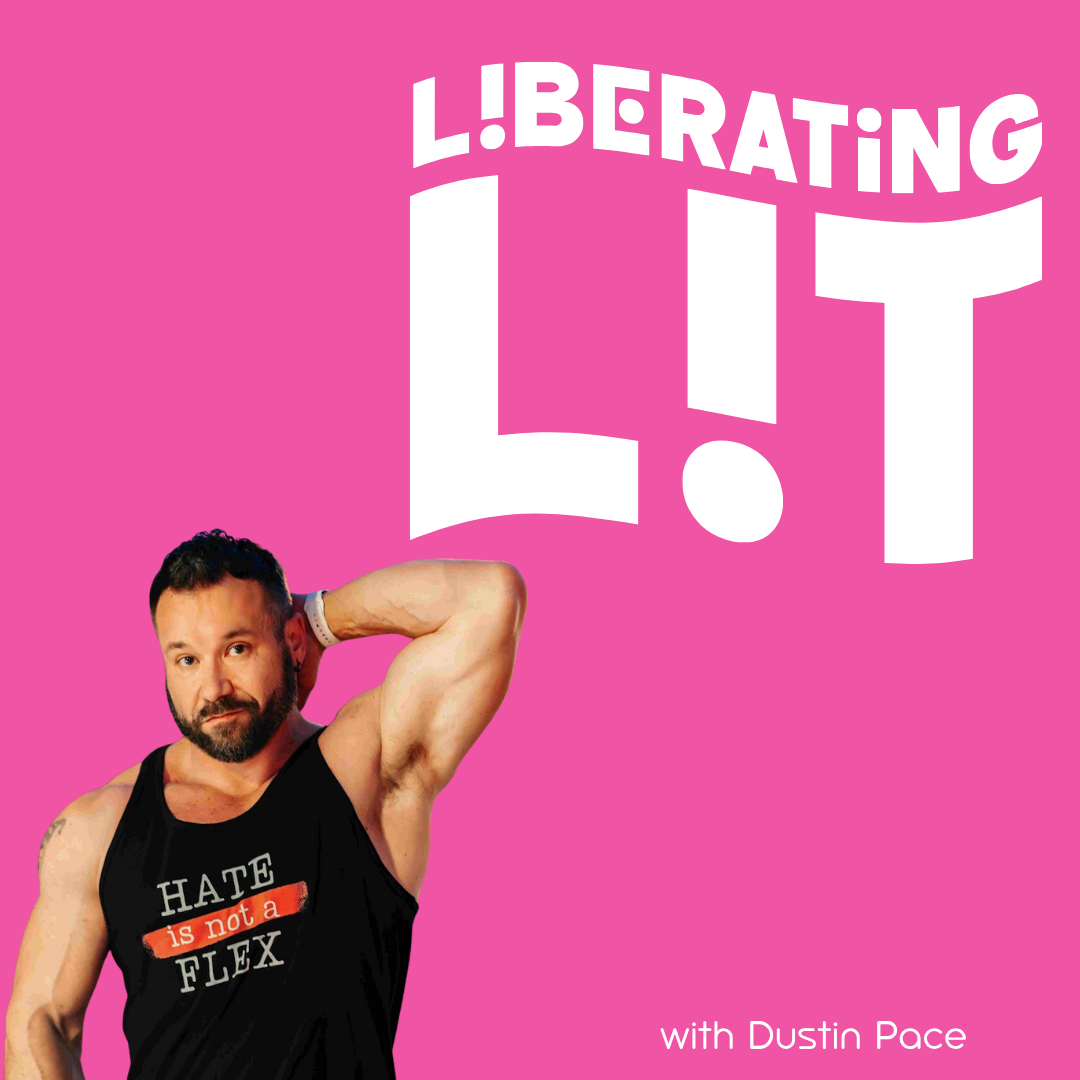
If you’ve been on the bookish internet, you’ve seen his videos. Dustin Pace–AKA, the guy behind Non-Toxic Masculinity–talks about the importance of social emotional learning (and why those books are targets for censorship), how public education is the backbone of democracy, and the power we have to make change using our unique voices and perspectives.
Show Notes:
“I’m Leaving Teaching Because I Believe in It Too Much” by Dustin Pace
Fahrenheit 451 by Ray Bradbury
Walter Masterson trolling Moms For Liberty
The Grapes of Wrath by John Steinbeck
Hadestown
The Handmaid's Tale by Margaret Atwood
Dead Poet Society
Transcript
Kelly Jensen/Liberating Lit (00:01)
I'm going to start this episode with a quote.
“What started as sharing books that help make sense of the world around us and challenging a toxic version of masculinity has become something much larger. A space where people come together not just to consume content, but to think, to question, and to push back against the idea that education should be something to fear. Because of that, I've been given the opportunity to speak more freely, to reach more people, and to do this work beyond the walls of a single classroom. So after a lot of reflection, I have decided I will not be returning to the classroom next year.
I love teaching, I love my students, and I love the strange, exhausting, meaningful rhythm of a school year, but I cannot fully defend public education while being confined within it. The fight for education is no longer contained within school buildings. It is happening in public discourse, in legislation, on social media, and in the stories we tell about what education is and what it should be. And that is where I need to be.”
Those words come from an essay by Dustin Pace, published in March 2026. Dustin, who hundreds of thousands of people better know as the person behind the social media account Non-Toxic Masculinity, is a former classroom teacher who has found tremendous meaning and community by sharing the power of books and reading online.
His presence and his message are potent. All young people deserve the right to read what it is they want to read, and it's important to dissect and dismantle systems of oppression that are built from toxic masculinity.
I've gotten to know Dustin's work the same way so many others have. He popped up on my social media feeds thanks to the algorithm, but unlike most things that land in my feed, his is a welcome and celebrated presence. As I dove deeper into his story, I found someone whose story parallels so much of mine.
We learn sometimes that the best way to change systems that we believe passionately in is to do so from the outside. It doesn't change a fundamental belief in the power of public schools or in public libraries. It is instead a recognition that sometimes working from within the system is no longer viable. Working outside the system is.
Welcome Dustin. I am so thrilled to have you here.
Dustin (02:23)
Likewise, thank you.
Kelly Jensen/Liberating Lit (02:25)
Let's start with the basics. Tell me who you are and what you do.
Dustin (02:31)
I'm Dustin. I make videos about banned books mainly, but you know, I also advocate for social justice and just trying to change things for the better.
Kelly Jensen/Liberating Lit (02:49)
It's not a “just.” That's a pretty big and meaty set of causes.
Dustin (02:51)
Okay. Yeah, I mean. There's a lot.
Kelly Jensen/Liberating Lit (02:57)
What was the spark? What got you into advocacy?
Dustin (03:00)
So I think I've always been into advocacy. In fact, I was probably just as into advocacy in high school. I probably got away from it for a while. I think I've always just kind of been a dreamer, like John Lennon says in “Imagine.” I don't know. I think I just saw the way things could be instead of the way they are and that's what drives me.
Kelly Jensen/Liberating Lit (03:40)
There are cis men engaged in advocacy work, and I wanna be clear that I'm not downplaying that at all here. But there is a dearth of cis men doing advocacy in the literary and library space. Why do you think that is?
Dustin (03:54)
I think I think part of it has to do with the fact that cis men are probably among the lowest demographic of readers and as a result, they're not going to advocate for it. In fact, anybody who is less literate is probably going to push back against it because nobody likes to feel less intelligent than somebody else. And so there's this mountain that we're up against of people who are willfully ignorant and then they wear that as a badge. And I think that's one of the problems that we're facing.
Kelly Jensen/Liberating Lit (05:10)
Do you think it has anything to do too with both literary work and library work and even education being more typically portrayed as feminine pursuits?
Dustin (05:29)
Yeah, I totally agree. And I think I mean, I was an education major and a lit major. Like I've been a man in female dominated spaces a lot of the time, and so that probably has informed some of what I do. But I do think that there is this notion that reading, and especially reading fiction, is feminine, right? I believe that that is one of the most important genres for men to read and in fact, if we're talking about the male loneliness epidemic which has received a lot of coverage lately, one of my firm beliefs is that if men read more fiction, read more poetry, like, that's going to stop. The answer's right in front of your face, literally. And you know, people just aren't looking for it.
Kelly Jensen/Liberating Lit (06:40)
Why do you think that is?
Dustin (06:43)
I think it's a lot easier to project our problems than to face them. It's much easier to look through a window than look in a mirror. And so it takes self-reflection to look to see what you could be or what is wrong in your own self versus projecting it onto others–and particularly women in this context. There's a lot of blame on women for men's problems when you know it's just stepping up. If you read some of the great novels or some Pablo Neruda, you can learn a lot.
Kelly Jensen/Liberating Lit (07:58)
I only wish that listeners could see a video because your facial expressions are sharing so much of your thoughts as well. So if you're listening, just know that there's a whole second like level of what's being said.
Can you talk about how toxic masculinity is related to book censorship and attacks on institutions of democracy, including public libraries and public schools? How can we, socially and culturally and politically, better prepare boys and men to step into advocacy and use their voice to support democracy?
Dustin (08:37)
Yeah, so that's a great question and honestly, I never thought these things would all be so interconnected. I guess that's part of the realization with me starting this platform, how all of these things really are connected and intersectionality I guess is something I talk about as well, obviously that, especially oppressed groups, are all interconnected. And so with toxic masculinity, a big part of it I think has to do with for one, the capacity that reading has to allow people to be more empathetic individuals and put yourself obviously in somebody else's shoes. So if you experience the world from a variety of different perspectives, you are less likely to have just a myopic worldview that privileges one gender or social identity. And particularly for men, then talking about toxic masculinity. Even just the notion of language itself being a function of the patriarchy of a male dominated society–so much of our language privileges men. Our thoughts, our language, everything centers around men and so reading and not necessarily I guess just reading, but studying language itself is a function of breaking down some of these social constructs that we've created.
Kelly Jensen/Liberating Lit (11:10)
That's a really fascinating perspective and one I hadn't thought about too much. Another guest on this show talked about some of the really interesting ways that the book internet, to put it in those words, talks about how they read in a lot of really sort of violent language. It's something I hadn't thought about before, but it's really true. And I like what you have to say, too, about thinking about the way language privileges certain genders and privileges certain perspectives. Reading builds empathy, but reading also gives you the tools to sit and think about those things and deconstruct them.
Dustin (12:01)
Yeah, absolutely. And I think that that is certainly something that is lacking in our society and especially with the doom scrolling and and just the constant feed that we are given is the time and that's another part of reading, right? That you are able to sit and think and it goes at your pace. You're not at the mercy of the feed and whatever that people are feeding you. You can sit and think, you can go back and reread. It slows things down a little bit.
One of the books of course that is super relevant is Fahrenheit 451 and Bradbury talks about how even just the replacement of the button with a zipper suddenly increases the pace of life and that's less time to think. And this is back in 1950, like the world has gotten exponentially faster since then. Now we really are lacking just this time for self-reflection and reflection in general to ruminate on the world.
Kelly Jensen/Liberating Lit (13:34)
Let’s go off script a little bit because this is really fascinating stuff. One of the big themes that we have seen in terms of censorship in the types of books being pulled from shelves is this social emotional learning piece. Why do you think that is? Why is that such a threat to those who want to censor books and those who want to decide that their parental rights are more important than other parental rights in the classroom?
Dustin (14:13)
Yeah, that is a great question. And honestly, it's pretty baffling. The social emotional learning piece we've seen here locally, too–that's one of the things they've come after for teaching in in the schools and it is baffling to me. I think the threat comes from the notion that somehow people are going to tell parents that they can't abuse their kids or have you know, corporal punishment, that sort of thing. That's all I can gather. But it's one of the most bizarre things to me because it went from Moms for Liberty going from critical race theory to then social emotional learning.
And part of it, I think, has to do with parenting because they came–at least locally here–they came after them for teaching gentle parenting, which is the most bizarre thing that I think I can imagine. Then they went on to talk about gender identity and things like that. They think it's some sort of Trojan horse for bringing gender ideology, right, to people. So it really seems like the trans and gender ideology is their background in all of the attacks at the moment and it's something that they can get people rallied around who don't really understand, who haven't haven't studied gender theory, and who maybe don't have a very nuanced take on gender. They use that and create a crisis that doesn't really exist. That would be my opinion.
Kelly Jensen/Liberating Lit (16:51)
Yeah, and so many of them overlap, too. Like the social emotional learning piece is part and parcel of studying different stories from different backgrounds, right? Like, you'd not just develop empathy, but you learn how to think, you learn how to feel, you learn how to consider other perspectives. And that being such a threat sure says a whole lot.
Dustin (17:20)
It really does. Walter Masterson has a video on trolling Moms for Liberty about that very same thing and it's pretty glorious.
Kelly Jensen/Liberating Lit (17:40)
Can you tell me who you learn from?
Dustin (17:45)
Who I learned who I learned what from? Everything?
Kelly Jensen/Liberating Lit (17:49)
Anything, your advocacy, your passion for reading, for connecting books with young people. I like to keep this question broad because sometimes there's a very clear answer and sometimes something else. I think people's approach to this question is fascinating, too.
Dustin (18:08)
Okay, so yeah, there's a lot there. I guess I would fundamentally have to say my mom read to me a lot as I was young and I guess I had a solid vocabulary and was pretty well read in in at least what they gave me, which was a lot of fairy tales and encyclopedias and things like that.
Later on I would say that I wasn't a huge reader in high school. I actually read a lot of Guitar World magazines and things like that because I wanted to be a rock star, which is still good. I still read a lot. But then I read Grapes of Wrath when I was in grade 12 and this is up in Canada, where we didn't call it senior year. It was grade 12, and that was the book that kind of changed a lot of my outlook and showed me what literature could be but also social justice.
Then certainly into college and beyond I would say that a number of professors and writing, probably as much as reading, was influential to me. I think writing has always been one of my strengths and so that probably led me as well into literature and the world of English and reading.
So I've learned from everybody. I've learned from my students probably more than they've learned from me or as much. I just try to learn from everybody.
Kelly Jensen/Liberating Lit (20:21)
And that is, I think, also one of the key themes that I've seen throughout is just this willingness and eagerness to learn from the people around you and the people that you interact with. I think, too, one of the threads that has come through is how influential family has been with encouraging reading. It is fascinating to think about that in contrast with what we're seeing from, you know, parental rights activists and what they do and don't want their young people to have access to.
Dustin (21:01)
Yeah, no, that is totally true. And so I guess there is a correlation between the two. I feel like I'm in an interesting place as well to speak about it because I did grow up in a highly controlled religious environment that was anti-education in some ways, but also privileged. It helped enable me to be literate and foster some of those critical thinking skills. I can see the threat of books and literature to a theocratic and dogmatic worldview. Part of the irony, of course, is that the very same people who are accusing schools of indoctrinating children are doing the very same thing.
Kelly Jensen/Liberating Lit (22:47)
Yeah. Bang on. Exactly.
One of the things that you have talked about is that to be an advocate for education, you've had to step out of the classroom. Can you talk a bit about where and how you made your decision to leave the field to be a better advocate for it? Where and how do you see this as being part of the challenge of these public institutions? Where and how do you see opportunities for those still in the field to do powerful work within the system? I know it's a nice, easy question.
Dustin (23:20)
Yeah, there's a lot in here and it is a really, really hard time to be a teacher. And if I compare it to even 10 years ago, the environment is totally different. Obviously some of these trends have been in the works for a while, but the attack on public education is intentional and it's not an accident. It's well funded, it's well coordinated, and teachers are doing the most amazing important work, yet they are being villainized and lionized by certain members of society. The same people would like to see education privatized but also put public funds to private and parochial schools in order to keep kids within their worldview.
So it comes back ultimately to this idea or this irony that we need to not indoctrinate kids but by indoctrinating them into whatever world view that is, which is Christian nationalism.
Kelly Jensen/Liberating Lit (25:01)
It's the contradictions in what is said and how it plays out versus what we really see beneath the surface is hard to ignore.
Dustin (25:20)
Yeah, and the language that is used, like Moms for Liberty, obviously they are not for liberty at all. But they're very good at just creating a slogan that sounds nice. Even like No Child Left Behind back in the Bush era–we were leaving all the kids behind. But if you have a nice slogan, then everybody just is like, well that's good or we can get behind that.
But what is presented on the surface is very different from what is happening behind the scenes and most people are not in the classroom day to day, obviously. And so it's easy to think that, well, I went to school, therefore I'm an expert on teaching or education. So everybody has an opinion because everybody was a student at one point. But that is very different than having to come up with pedagogy and lesson plans and you know, deal with the social emotional needs of multiple students at all given times.
Kelly Jensen/Liberating Lit (27:02)
It's a lot of being asked to do the impossible and being asked to do the impossible with no time, money, budget, and plenty of people who have a lot of opinions about how you do it.
Dustin (27:12)
Right. Yes. Exactly. And so I think part of what I'm doing and part of what drives me is the notion or the firm belief that public education is the backbone of a democracy and a free society. And I think that given all the problems with the United States and the American experiment, that was one of the absolute best ideas. It is essential to creating a free society. If we are attacking public education, we are undermining democracy itself.
Kelly Jensen/Liberating Lit (28:08)
Perfect. Exactly. I couldn't have said it better. That's exactly it. And I think so often that the connection between public education and democracy is not highlighted enough. It's not emphasized enough what is really at stake when public education is, you know, burned at the stake, if you will.
Dustin (28:36)
Yeah, absolutely. And it also is, I would say, the great leveler or it should be the great leveler. Everybody should receive the same opportunities. Every child should receive the same opportunities to succeed and excel. When we start pulling funds from public education and putting them into private schools or charter schools even, then we are taking away from the students who already don't have advocates in their corner.
And so yes, anybody could apply for a charter school, but people who don't have a parent advocating for them already are not going to get that same opportunity. So we're already selecting the privileged to have better opportunities than the less privileged.
Kelly Jensen/Liberating Lit (29:44)
What keeps you going?
Dustin (29:48)
At this point, I don't know. Caffeine and a blind rage, I guess. But I guess I'm just stubborn enough to keep on keeping on. And I'm an idealist enough to see how the world could be.
So one of my favorite musicals–I've directed musicals for a number of years here–is Hadestown. There's a line in there about seeing the world as it could be instead of how it is, and that's in reference to Orpheus. And he is an idealist. He's contrasted by Hades, who is older and more jaded in the musical and in the story. I have elements of both in me, I guess, and I can relate to both, but there's a part of me that wants to create the world I saw. Now that I've gotten a little bit older as well, there's also the Hades part that sees how much different the world has become than what I thought it would be. So that combination, I think, keeps me motivated enough to create or try to create awareness kind of on both sides of the coin of what grieving the world that I thought would be and also trying to create the world that I wanted.
Kelly Jensen/Liberating Lit (33:17)
So I think you kind of answered this–whether facetiously or not–and also I could just kind of guess what your answer might include to this question, but it is what kind of self care do you practice?
Dustin (33:33)
Not enough. But some of my self care I guess would be working out and the therapy. I started therapy here in my 40s and I should have started it as a teenager. I should have started it in my 20s. Like the one thing that I would have done differently or done better is handle my emotions, learn how to address painful feelings, learn how to address the things that I didn't want to. And so years later I am still wrestling with emotions from, you know, 20 years ago. If there's anything that people can take away from that or from young men and what I'm doing is that get a therapist and just deal with your shit.
Kelly Jensen/Liberating Lit (34:52)
You are not the first person to say therapy, and I think it ties so much back to where this conversation started and how little emphasis, how little access, there is to learning and talking about emotions and feelings–that very social emotional learning stuff that, you know, you can't know it unless you learn it. And if you can't find a place to learn it, you find yourself in your 40s going, I wish I had known 20 years ago, 30 years ago.
Dustin (35:33)
Yeah, and men get a lot of blame and rightfully so, but I think we've been failed in a lot of ways, too. I would say that the social emotional learning part and dealing with our emotions and talking openly about them is probably one of the biggest ways. I think that if we could encounter and address that problem, that many of society's problems would probably get a lot better also. Because if you look at the number of violent crimes, if you look at the number of sexual assaults, of all of these things, they probably stem back from stilted adolescent man children, you know, who don't know how to channel and address their emotions.
Kelly Jensen/Liberating Lit (36:52)
What advice or thought would you want to impart on somebody just getting into literary advocacy?
Dustin (36:59)
I guess show up at your school board meetings and speak out against Moms for Liberty.
I think that the biggest thing is probably to read and then to show up when you're needed because there are a lot of places that you are needed. Those places are the library board meeting, they're the school board meeting. They're not the national monument or showing up in Washington or anything like that. They're showing up at your local board meetings and they're showing up to vote for those small elections also. People don't realize how much effect those little details have, but that's where the real change happens. It's supporting your teachers, it's supporting your librarians also, because they need it. It's a hard time for teachers and librarians right now.
Kelly Jensen/Liberating Lit (38:33)
Same question, but what advice or thoughts would you want to impart on those who've been doing this work for a long time?
Dustin (38:41)
I guess that part is just don't give up. It's relentless to just show up day after day and it is getting harder. It seems to be getting harder. The emotional toll weighs more on me, you know, now than it did a year ago. But we are making a difference and celebrate those victories. We do get some victories here and there, and it's important to take those wins to celebrate those wins because they are important. When you know, the ACLU fights and gets a win or you know, we get a little win in court, then celebrate those because we're making a difference when decisions or public pressure influences something.
We have seen–and this is one thing that has been maybe most rewarding is and I'm not taking full credit by any means or even you know that much credit at all–but like when the Alberta book bans happened at the start of the school year and I had a video go viral up in Canada and there was a lot of public pressure. Then the Alberta government changed their ministerial order. That was a win. Like we were making a difference. That's making a big difference. They still instituted a book ban targeting graphic novels, but with much less broad language and so there's still more to fight but it made a big difference to the public outcry. The same thing in Tennessee more recently when they banned Roots of all things, and you know there's enough public outcry that they went back on that as they should. But it is motivating and reassuring when we are making a difference, and we are.
I think that's one of the things that often gets overlooked because we're just like, another book ban, another book ban, another book ban. But then when we can see that, hey, we're making a difference–they are changing some of these because people are pissed off.
Kelly Jensen/Liberating Lit (41:16)
I think there's a lot to say, too, in, you know, owning that the work that you're doing–and I'm speaking specifically to you as well as more broadly–it does make a difference, right? Like a video going viral is a huge deal because it gets that information across to people who may have not otherwise never seen it, or they have seen it or heard it in a way that they couldn't apply to their own life or to their own experiences, right?
I always think in terms of the more ways a person sees or hears a thing, that is more opportunity to reach them. Because sometimes it might not be in, you know, academic language, it might not be in data, it might be a video of you holding some books and saying, “This book is important because this is what your government wants to take away from you.” That might be the thing.
Dustin (42:10)
It really wasn't planned for what I was doing, I just ended up in a bizarre intersection of sort of being a meathead and reader and really passionate about banned books. It's something I've always had my students do. I've always taught about banned books, and so when the attacks started coming more and more, I just started making some videos. I was also doing the social justice advocacy and so it really is a a bizarre intersection of my life's passions, I guess, that somehow coalesced into this platform but you know this shirt kind of sums everything up.
It’s three short sentences, but 42 years of my life that just came out one day and it's humbling how it resonated with people. But it's also really inspiring to see people kind of get behind the message.
Kelly Jensen/Liberating Lit (43:32)
And since we are audio only, the shirt says “Read Books. Lift Weights. Fight Fascists.”. It's perfect.
I’ve got one last question for you, and it's this: because this is a podcast about liberating literature–liberating in all senses of the word–I end each conversation the same way by bringing it back to books. Can you talk about a book that's been influential in your life? And this can be a book that inspires you or a story that's just stuck with you for some reason.
Dustin (44:04)
Okay, so there are a lot, and this is a tough one. But The Handmaid's Tale is my number one book whenever I'm asked this question. I think it has to do with not only for one, I'm from Canada, so I have a little bit of Margaret Atwood pride, but the way that it influenced not only my view of the world but of what literature could be and especially of women's rights and of feminism. Coming from a highly controlled religious environment as well, I could really see where everything was headed and it has headed. And so it's a scary book because it is happening kind of in real time. But Atwood also has just an amazing command of language and the way that she can convey not only the message but the way that the words themselves jump off the page just is fascinating to me. I love a lot of her books but I think The Handmaid's Tale, if I had to pick one book, that would be it.
And then speaking of stories, musicals are a big part of my life and I talk about Hadestown earlier. I'm gonna put a plug in for that. I'm not sponsored by Hadestown or anything, but if you have a chance to check it out, it is so good and so powerful. That's another form of storytelling as well. I know it's not literature, but it kind of is.
Kelly Jensen/Liberating Lit (46:13)
It's totally literature. And we've seen, you know, theater has been censored during this era as well. I think people forget the reason that it is so powerful is because it is words and language and storytelling.
Dustin (46:33)
I guess another story, if I had to bring it full circle, is Dead Poet Society. That's probably the reason I am a teacher. There is a line in that about law, engineering, medicine are all noble pursuits and necessary to sustain life, but music, art, poetry–these are the things we stay alive for. That to me is why the arts and humanities and literature are important. They're more under attack now than ever, but they're more important now than ever.
Kelly Jensen/Liberating Lit (47:34)
I can think of no better way to end this conversation than on that note. So thank you so much for joining me today.
Dustin (47:41)
Yes, thank you so much. This has been really fun.
