
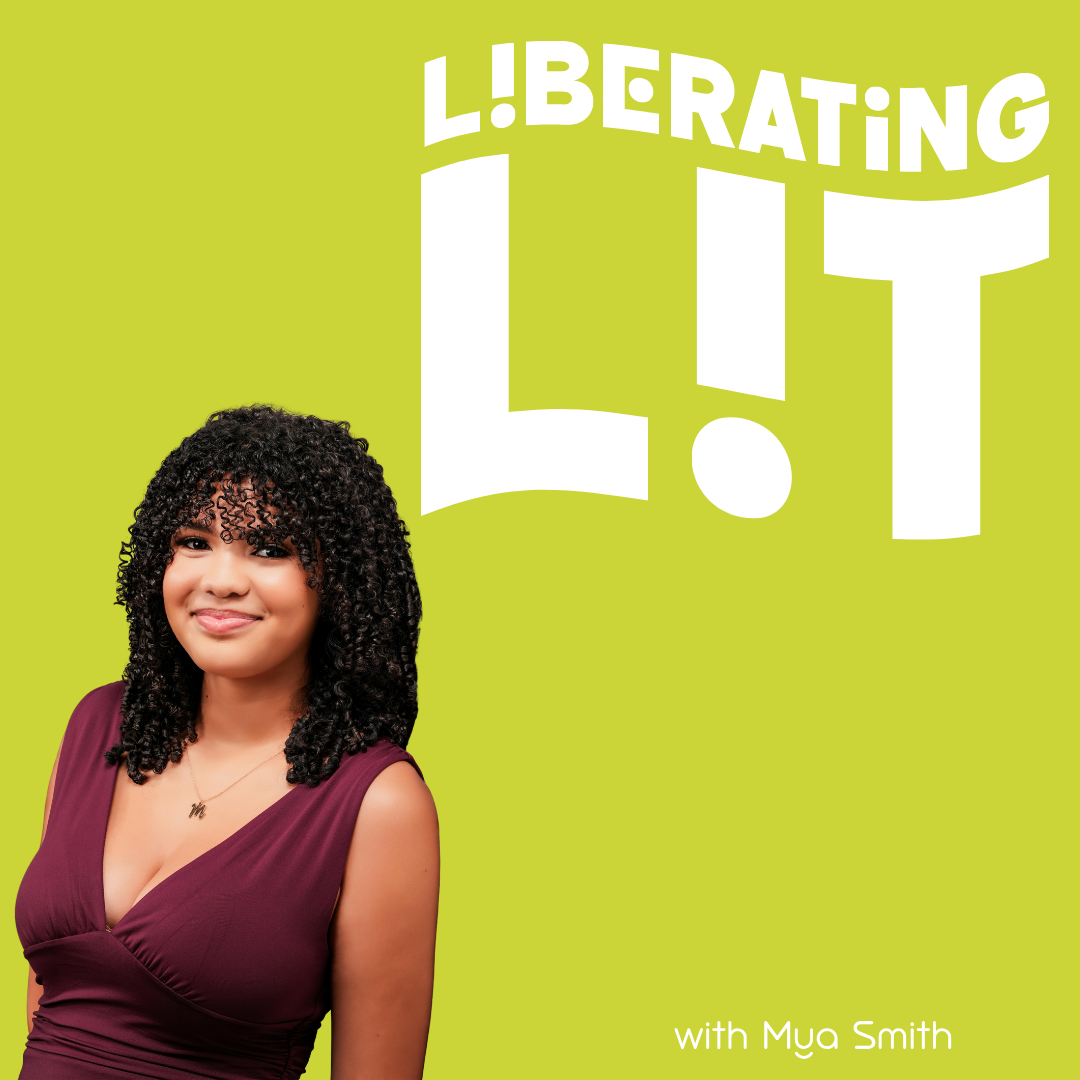
Mya Smith is a Duval County, Florida, high school student. When she learned that she could not borrow books from her school library, she met the reality of book bans head on–and she decided to do something to help her fellow students understand what was being taken from them and others across the country.
Show Notes:
Words on Trial documentary
“‘Words on trial’: One DCPS student is taking a stance against book challenges and removals” from News4Jax
The Glass Castle by Jeannette Walls
The Perks of Being a Wallflower by Stephen Chbosky
To Kill a Mockingbird by Harper Lee
Little Women by Louisa May Alcott
Transcript:
Kelly Jensen/Liberating Lit (00:01)
It is young people who are most impacted by school and library book bans. Despite claims that books aren't being banned because anyone can just buy them from Amazon, the fact is that yes, books are being banned, and no, people can't just run and buy them from Amazon. When a book is removed from a public institution like a school or library, that means access is denied to those who use those institutions.
Libraries are about access, and when a book is pulled from the shelf because of an ideological complaint, young people are denied their right to access the material or it was once available to them. They now need to surmount any number of hurdles–money, transportation, time–to get their hands on it. Hearing what young people are doing in response to book bans is crucial for understanding not just how they're impacted by censorship. It's also crucial for seeing where and how they're learning about their rights, the power of their voice, and how creative they are in responding to the issue. These are all lessons and skills that will carry them forward and continue to build their lifelong advocacy skills.
There's also no doubt adults can learn so much about advocacy by watching young people do the work. Young people shouldn't have to do this, but when they do, we need to pay attention.
Mya Smith is a high schooler in Duval County, Florida. Her district and her state more broadly have been an epicenter for book censorship since 2021.
What happens in Florida doesn't stay there. Successful censorship tactics are then employed in other states across the country. No matter how easy and convenient it would be to write off an entire state because of its politics, the reality is these states aren't just pieces of land. They're composed of a wide array of people, many of whom have been long disenfranchised or victims of voter suppression. And even if history didn't explain the present, there are so many good people doing good work in tough conditions, and their voices, stories, and work deserve to be championed.
Mya is one such example.
Mya found herself growing as a reader, and as young people who've discovered the power of books do, she went to her school library to borrow titles. That's when she discovered she couldn't check anything out. As she told News4jacks earlier this year, “I realized that it wasn't just banned books, it was the fact that I couldn't go to my school library for any book at all. And I think that's what saddened me and made me want to figure out why this is.”
What resulted was a short documentary called “Words on Trial” about the state of book bans across the country. It's evident how much work went into developing this film, and it's the kind of viewing that should be required not just for other young people, especially those feeling alone in their experiences of being intentionally denied access to books and libraries. It should also be required viewing for adults, including those who understand what's at stake right now, and those who refuse to put a face to what it is they're doing.
Something that stood out to me in Mya’s film was that the bulk of those interviewed on camera are people of color. We know books centering these voices are among the most targeted, but it's also frequently the case that those voices aren't centered in discussions of the impact of the censorship. Mya does just that and more in under six minutes.
I am thrilled to talk with Mya on the show about advocacy and about the realities of censorship on young people.
Welcome, Mya.
Mya (04:06)
Thank you for having me.
Kelly Jensen/Liberating Lit (04:08)
Let's start with the question I ask every guest, which is: tell me a little bit about who you are and what you do.
Mya (04:16)
Hello, my name is Mya Smith. I'm from Jacksonville, Florida, and I am going into my senior year of high school. Last year I made a thesis film called “Words on Trial,” which was exploring banned books as you said, and that kind of inspired me to just dive more into the topic and to learn more about book bans and censorship.
Kelly Jensen/Liberating Lit (04:37)
What was the spark? What got you into advocacy?
Mya (04:41)
I really got into advocacy because I realized that I wasn't able to check out books and that so many books are being banned. Commonly read books in schools aren't being read anymore by many students and I just realized how unfair that is. I wanted to get into why and try and see what I could do about that.
Kelly Jensen/Liberating Lit (05:00)
Can you talk about how you discovered that you couldn't use your school's library and maybe talk about what that experience was like?
Mya (05:09)
Well the experience was a sad one because I was getting into reading and buying books is not always reasonable for everyone. So I wanted to go to my library. I asked a friend about it because she frequents that area since she's a creative writer and she told me that I wasn't able to check books out. And I was really shocked. I thought maybe something was wrong. Maybe she didn't really fully know what was up, so I went to the teacher in that area and she told me I couldn't check anything out. She said the books aren't even read by the students who have classes in the library and they're really just there for decoration. And that kind of started everything because I thought it was just so unfortunate that that was the case.
Kelly Jensen/Liberating Lit (05:48)
When I talk to adults on this podcast, I talk with them knowing that they're readers and advocates of access to books through libraries. And one thing you've said before is that you found yourself getting into reading in the last few years. What book or books were the titles that got you really excited about reading and what it offers? And was there a moment or experience where things clicked and you realized just how fun and powerful and exciting books in the library could be?
Mya (06:15)
Yes, so the book or books that really inspired me was the Harry Potter series. I know I'm really late to the game. It's mostly read in like kind of elementary middle school time, but back then I wasn't really I wasn't really inspired to read. But I just decided to pick it up because I've always been a fan of the movies and the film franchise and the films are very good. I love them. They're some of my favorite movies. But the books, you're just fully immersed in a world and I didn't know that books could do that. I didn't know that was possible.
When I discovered those books and I read them all within a couple of months, I was like, I need to read more. I need to see what else is out there. And that really inspired me to get into reading as a whole. Because I just wanted to see, like, if this person could do this to me, like what other books are going to be able to get that feeling.
Kelly Jensen/Liberating Lit (07:05)
Can you talk about what inspired you to make your documentary “Words on Trial” about book censorship? I know this was for a class project, but it's also available on your YouTube channel. What more would you like to see for the film? Like what kinds of dreams or hopes do you have for it?
Mya (07:21)
I was inspired to make “Words on Trial” because I wanted to tell a story that was important and a story that mattered. Typically for these thesis films, they are narrative. And I've never been a big one to make narratives. I typically do documentaries in the first place. And those documentaries are typically centered around people in my community. I have highlighted small business owners and things of that nature.
But for this film, I wanted to highlight something that was going on in the world, and I decided to pick book bans because it was something that I was discovering right about that time. So I thought it was the perfect thing to do.
As for things that I want to see from this film, I just want people to be more educated on the topic, but also, I hope to inspire people to look into it more, read into it more, and see what they can do about the issue. I just really hope it gets people inspired to see what they can do about the issue.
Kelly Jensen/Liberating Lit (09:24)
Where and how did you begin the research process for your film? Were there any resources that were helpful or were there resources that you wish existed when you were putting this together that didn't?
Mya (09:36)
Some helpful resources for researching were definitely just Google. I was looking up things like banned books and different organizations in my community. I also found a lot of people through Instagram as well.
As for resources that I wish existed, maybe honestly if there was something within your school that you could see like what different organizations that you could join like outside of the community. I think it would be nice if things like that were advertised because my school advertises in-school clubs, but maybe if I would have known about these organizations before now, I would have joined them much earlier if my school actually put these organizations out there.
Kelly Jensen/Liberating Lit (10:16)
That's such a great answer and not something that I've thought about. Because I know I've seen there are schools around the country that do like banned books clubs, but those are school sponsored as opposed to being from outside the community and inviting students to take part in it. I think that's really great insight for anybody who does banned books and censorship work– making that effort to connect with somebody in the schools and let them know that students are welcome.
Did you have any moments in making your film where you walked away with advice or insight that helped you in your own advocacy? Or maybe another way to ask this is what's gotten you excited about doing literary advocacy in the midst of creating and sharing your short film?
Mya (11:06)
I think while making my film I realized the importance of supporting the little guy, supporting independent bookstores and libraries and like I've already said, getting involved in organizations. Like buying books for Amazon–there's just really not much benefit to it because you're not supporting the little guy, you're not supporting these businesses that are out there that might even be struggling.
But also what I've noticed is a lot of bookstores have communities and you can join a lot of communities through bookstores as well as things like book clubs and get connected with people who are already into advocacy.
Kelly Jensen/Liberating Lit (11:46)
That's a great answer.
What has been some of the response to your short film? What maybe has surprised you about that response?
Mya (11:57)
The response to my short film has been good, thankfully. I think it's been eye opening to a lot of people who weren't aware of what was going on because unfortunately literacy rates have declined a lot. There's not very many people nowadays who read for passion and read for enjoyment. I think people walked away just learning a little bit more. I'm not sure how many people are actually actively getting involved, but I'd like to hope that a lot of people are starting to even just pick up a book if they haven't done that in a while.
Kelly Jensen/Liberating Lit (12:26)
What did your classmates think about this?
Mya (12:31)
My classmates, I think they liked it a lot. It sparked a lot of conversations, which I liked, about books and about book bans in general. Even so many people in the creative writing department at my school are talking about, yeah, the books are just kinda there and they want to read the books, but those students in there aren't even able to read them either.
Kelly Jensen/Liberating Lit (12:52)
And I bet that got them thinking about where and how they can make a difference then, too.
Mya (12:57)
Yeah, I think it did.
Kelly Jensen/Liberating Lit (13:00)
Obviously you've been more exposed to banned books in the last year than before you embarked on your advocacy journey journey. What are one or two banned books that you've read that you think everyone should read and what made them meaningful for you?
Mya (13:13)
So two banned books specifically that I think everyone should read are The Glass Castle as well as The Perks of Being a Wallflower. I think both of these books, they're just enjoyable reads, but they also are great examples of overcoming challenging relationships with others, but also just challenging circumstances. They're good reminders that you can get through anything if you put your mind to it and if you find people who can rally for you.
Kelly Jensen/Liberating Lit (13:45)
Have you picked up any banned books since you started this journey that have surprised you, even if they haven't necessarily been ones that have been your favorite?
Mya (13:55)
Hmm, that's a good question. I think a book that inspired me was To Kill a Mockingbird because it was a book that was so frequently read in schools up until recently. And I read it and I was just so confused as to why it was banned. And that's when my reaction to so many banned books, like I haven't read a banned book that I was like, this should be banned. All of them I'm like, no.
But To Kill a Mockingbird, I think is just a story that everyone should read. It should be required reading. And that was really my reaction when I read it.
Kelly Jensen/Liberating Lit (14:36)
That one is a really shocking one, I think, for a lot of people because it is a book that has been so widely read in schools for generations.
Mya (14:46)
It's just crazy that it's something that isn't read now.
Kelly Jensen/Liberating Lit (14:51)
Who do you learn from? And this could be in the process of making your film or more broadly, like the people you look up to and find support from, whether or not you know them in real life.
Mya (15:02)
I really learn and look up to my parents as cliche as it sounds, they've always supported me through every endeavor, any film idea or thing I wanna do or book I wanna read. They're always going to do everything in their power to support me and make sure that I'm able to achieve what I dream.
Kelly Jensen/Liberating Lit (15:23)
Are there any individuals or groups doing advocacy right now that you wish more people knew about, or they're doing cool things that you'd like to share?
Mya (15:32)
I would love to shout out Rebel Readers. It's an organization run by two lovely ladies, Katie and Casey, who are former educators. I actually interviewed them in my film and the thing that I think is special about them is that they are working in advocacy alongside their day jobs. I think some people are fortunate because they're able to work for these organizations, but that isn't possible for everyone. So in their free time they are placing books into Little Free Libraries, which is getting books out in the community in places where books might not be accessible to people.
Kelly Jensen/Liberating Lit (16:13)
And it just makes it a creative way to bypass some of the laws and restrictions that are put into place in places like schools and public libraries, right? It gives you more–you know, you wish that the laws could be changed and you work towards changing them, but there comes a point where it's like you still want people to get the books somehow.
Mya (16:35)
Yes, and another thing that I like about them is they have a website where you can actually go and request certain books to be placed in one in a Little Free Library that's nearby you. So it's an even easier way to not just get access to any books, but books that you really want to read but you might not be able to due to your circumstances.
Kelly Jensen/Liberating Lit (16:55)
That is a really clever way to do it.
Mya (17:00)
Mm-hmm. I agree.
Kelly Jensen/Liberating Lit (17:02)
Where and how are you seeing other young people–middle schoolers and high schoolers especially–engaging in freedom to read work? Do you find that your peers, whether in your school or elsewhere across the US, are as fired up about the topic as you are?
Mya (17:18)
I see many people my age just shocked and fired up, whether they knew about it before my film or not. I think they're just shocked that we're not able to check out books. And I've even seen people, maybe not people that I know, but people posting on social media just about how crazy it is and just trying to do what they can through the avenues that they can.
Kelly Jensen/Liberating Lit (17:40)
I feel like your film and the work being done by young people across the country, you know, whether that is creating banned books club in their schools or in their local libraries, their local bookstores, or one example that comes to mind is SEAT, the Students Advancing Education in Texas, whose work has really been focused on trying to get legislators to understand what's happening and how students have rights in education, too.
I think that all of these things, whether they are big and broad on the state level or they're really localized, like your film, which is centered and created in your school and yet has a reach through your YouTube channel and through people who are finding it and sharing it. I think that that really helps spread the word to more young people who, you know, for reasons that make all sense in the world, don't know what's happening. Like why would you know what's happening unless you've been personally impacted by it or you are with you know, engaged with an organization that's doing this work and keeping you up to date.
Mya (18:44)
Yeah, I agree. Social media and just the news in general has been such a good avenue to spread awareness with what's going on. I think it is super important to be seeing the things that you can do in your community because maybe you won't be able to change everything for the whole United States, but you might be able to do something for the kids in your community, even just in your neighborhood. And I think that's really special and important.
Kelly Jensen/Liberating Lit (19:06)
Absolutely. Anything you can do, any change you make matters, and it has this ripple effect, right? Like that the idea that you mentioned of the group The Rebel Readers, that you can request titles for Little Free Libraries to have those titles in is so localized in such a smart way because it can really then help the kids who find that there is this one specific book they want and they can't go buy it or they can't get it at the library. They have transportation challenges, but they can say, you know, this Little Free Library is a block away from my house would be a great place to drop this title because then it becomes more accessible for somebody like me who is really itching to get my hands on it and can't.
Mya (19:50)
I thought it was such a clever idea. I didn't even realize until I interviewed them. I thought at first they were just gathering up books, maybe taking donations to put in the Little Free Libraries. But then when I realized like they were actually taking people's suggestions, that like, I need this book here, I need this book here, I thought that was just such a cool idea.
Kelly Jensen/Liberating Lit (20:07)
Yeah. I'm definitely gonna make sure I link that in the show notes for anybody who's listening because I think that's a really, really powerful way to skirt some of the logistical challenges of getting these banned books to the people who are really eager to pick them up.
One of the questions I ask my adult guests is what keeps them going in every episode. But I'm gonna ask you a little bit of a different take on the question, which is where do you see yourself going next?
Mya (20:39)
I see myself continuing to do what I can, whether that's just informing people at my school of what's going on. I might make another film, who knows? I don't have everything exactly planned out right now. And of course I just hope I will be continuing to read, of course.
Kelly Jensen/Liberating Lit (20:58)
Honestly, if all you d– and I don't think you will–but if all you do is read these books and talk about these books, that makes such a tremendous impact. Especially because you're talking to the very people who need to know these books exist, who will pick up these books somehow, or at least know that they exist and realize that there's this challenge in getting access to them and that, hey, maybe they can do something about it too.
Where and how do you wish adults could better support and advocate on behalf of young people who are losing their access to books and libraries?
Mya (21:36)
For starters, that adults would read the books that are most frequently banned. Because if you read these books, you will most likely question why they're banned, or at least I hope you would question why they're banned. And maybe at that point you will see what you can do as an adult to benefit children and fellow adults, because maybe even adults, they might not be able to always go and purchase books that they would like to.
And another thing is just because you don't want your kid to read a particular book doesn't mean that it should be wiped out across the board. I think that's another thing people need to realize is that you can dictate the books that your kids read if you choose to. I think that's important, especially for certain ages. Kids probably shouldn't be reading certain books. But that doesn't mean you should stop everyone's child from being able to do that.
Kelly Jensen/Liberating Lit (22:32)
Perfect answer.
Mya (22:35)
Yeah.
Kelly Jensen/Liberating Lit (22:36)
What kind of self care do you practice?
Mya (22:39)
For self-care, I am a huge film nerd. I love just watching movies and I think it is a perfect escape from reality. I, of course, like I already said I love Harry Potter. This summer I finally watched Star Wars for the first time and I'm obsessed. And just TV shows as well. Like I think it's just the perfect way to escape. And of course reading as well is another form of self care for me.
Kelly Jensen/Liberating Lit (23:07)
I often ask this in the context of adults talking with other adults, but I'd love to ask this to you when thinking about other young people. What advice or thought would you want to impart on somebody just getting into literary advocacy? Where and how can the average middle or high schooler begin to do something about censorship?
Mya (23:28)
I would suggest anyone, no matter their age, to get involved in their community and local organizations. Go to your library and see what you can do. See if you can volunteer somewhere or donate your time. That's so important to the cause.
And like I've already talked about, social media is such a good avenue to spread awareness as well to people who might not be aware of the topic. Everything helps. Another thing could be like showing up to school board meetings and even joining it part in protests as well.
Kelly Jensen/Liberating Lit (24:01)
I'm going to ask the same question, and I think some of your answer will probably be very similar, but I'm asking this time what you would want adults to think about when it comes to literary advocacy for young people. What should they know and why should they get involved in protecting your right to read?
Mya (24:19)
I think it is crucial that adults get involved in literacy advocacy for young people. As kids and children, we can only do so much. We need adults to get involved and support the cause. And this can really be done in so many ways. You can donate books to Little Free Libraries, you can get involved in local organizations, and you can also vote for people in office who are going to support this or not support book bans, but support literary advocacy.
Kelly Jensen/Liberating Lit (24:54)
Because this is a podcast about liberating literature and I use liberating in all senses of the word, I end each conversation the same way by bringing it back to books. Can you talk about a book that's been influential in your life? This could be a book that inspires you or it's a story that's just stuck with you for some reason.
Mya (25:14)
A book that has been influential in my life is Little Women by Louisa May Alcott. It was a book that I read this summer, and I think it stuck with me because it's a story about girlhood. I think there's so many books out there for so many people, but this one is really for the girls. It's showing that the stories of women and girls are enough. You don't need these flashy superheroes or crazy things to be going on, like fantasy, like it can just be the stories of girls. And it also shows that no matter what you want to do in life, your dreams and your aspirations are important. Like all of the sisters are so different, and that is perfectly okay. They can still all support one another and rally behind one another. And I think it was just a touching story, especially because the main character Jo–I feel like I related to her in so many ways. So that's another reason why I think it has stuck with me as a book.
Kelly Jensen/Liberating Lit (26:16)
I want to end by just saying how cool it is that your reading life and your interest in reading has been quite recent, and yet you have rattled off so many books that you have read and are passionate about. You probably read more books than the average adult does, and you're doing that while juggling school and all of your offline activities, all of your extracurriculars.
I'm going to actually ask one more question. I don't tend to ask this question, but I think it's really important for adults to hear, especially. And that's how can adults encourage young people to read more? Maybe part of that question can also be: what would you say to an adult who hasn't picked up a book in a while and should pick up a book?
Mya (27:12)
So starting off with your first question about encouraging young people to read, I think the best way is really to start out when your kids are younger, if possible, just doing things like taking them to the library frequently. I know the library has so many programs that you probably aren't even aware of. I worked there over the summer and I didn't even realize half of the things that they were doing. So just taking your kid to the library, but also just encouraging them to read by giving them books and allowing them to explore books of different genres, especially as they're getting older, because they might like one specific thing or they might like a variety of different things. It might take a while before your kid finds exactly what they like. Also, maybe just encouraging them to read every night before bed, like starting off very small, simple, like 30 minutes, something like that. And then over time when they're finding the right books, they're probably gonna want to read more.
And then for your question about adults who haven't picked up a book. What are you doing? Pick up a book. There is going to be something for every situation that somebody may be in, you can pick up a book. If you are busy, this is something I always tell my friends when they're like, Mya, how are you reading so many books? Because I'll bring my book to school, and they're like, we just saw you with a different book the other day. And what I'd say to that is you prioritize the things that you want to do. If you want to spend five hours doom scrolling, you're going to do it. So if reading is something you really want to get into, or if there's another hobby or whatever that you want to do, you will make time for it. You will make time for the things that you enjoy.
You can make time for reading as an adult. Like even in nine to five, you can read during commutes. If you're a commuter, you can read a little bit before bed. You could read when you'd be scrolling on your phone. I could go on about this because I'm always trying to encourage my friends, like you guys, you guys got time. If I got time, you guys have time. And that's what I'd say for that.
Kelly Jensen/Liberating Lit (29:14)
Mya, thank you so much for joining me and for talking on a topic that is a big meaty topic and yet it's one that directly impacts you and that you have really found such passion for. Listening to you talk about reading and books and to listen to you teach adults how to do the work has just been such an honor. Thank you so much.
Mya (29:39)
Thank you so much for having me. I really enjoyed speaking with you.
Kelly Jensen/Liberating Lit (29:43)
I will, of course, include Mya’s documentary in the show notes so you can all watch it. I think it is eye-opening, and I think it is the sort of message that is easy to share as well. We have so many great people doing great work, but sometimes the shorter message does a whole lot.
Her film is one such example of that.
