
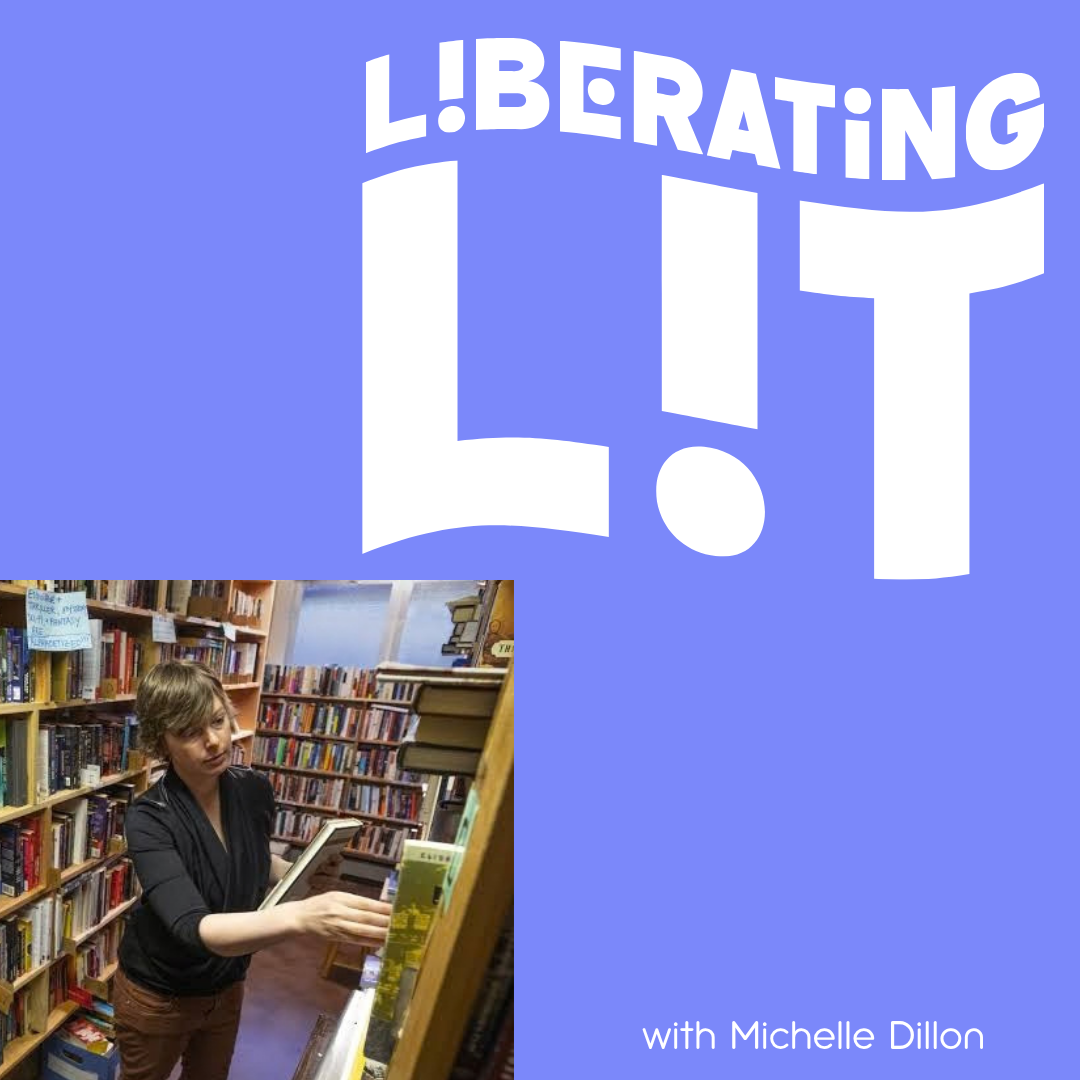
Michelle Dillon’s career and passion has been dedicated to prison censorship. In this episode, she talks about why censorship thrives in prisons, the work being done to provide books to those on the inside, and how the average person can help protect the First Amendment rights of justice-impacted individuals.
Show Notes:
“The Books Banned in Your State’s Prisons” from The Marshall Project
Furnace board game
FlipToons card game
Expanding Information Access for Incarcerated People Initiative (San Francisco Public Library)
Nickel and Dimed by Barbara Ehrenreich
The Grapes of Wrath by John Steinbeck
Spill Simmer Falter Wither by Sarah Baume
Transcript
Kelly Jensen/Liberating Lit (00:01)
What cannot get lost in the work to protect access to literature is the number one source of censorship in the United States: prisons. Prison censorship denies justice-impacted individuals the opportunities to grow and learn, and such censorship happens despite the ample research that access to books and reading and education in prisons reduces recidivism. While the goal for justice-impacted people should always be avoiding returning to the system, the fact is that the prison industrial complex cannot thrive without people housed within it.
Prison censorship is also part of slavery's legacy.
Prison censorship looks different than that in public schools and libraries. The censorship only comes from within the facility or within the government body that oversees the facility. It's even more subject to the whims of the people working in those institutions, too. Take, for example, states like Texas banning any hardcover books or used books from coming in the mail, even from its own approved list of vendors, in 2026. Their reasoning is that drugs are getting through the pages and the bindings. This isn't really happening. Books are becoming the scapegoat for those drugs coming in through other means, perhaps as the case may be from the mailroom workers or guards themselves.
Prison book ban lists are themselves telling. Depending on whether you're in a state institution or a private institution, in New Hampshire or in Wisconsin, what books justice impacted people have access to differs. At times, the facility may elect to deny access to a specific title, or a state prison system may decide to wholesale ban books by particular authors or on certain themes or topics. The record keeping related to book censorship varies widely, too.
According to the Marshall Project in 2023, roughly half of the US states even kept a list of books banned from their prison systems. None of this touches on the state of libraries and prisons, let alone access any justice impacted individuals may have to librarians. A rolling cart of battered paperbacks may be a nice library in many prisons. In rare cases, prisons may have a partnership with a local public or academic library. And in still rarer cases, there may be a part-time or full-time librarian and physical space within the prison for a library. But even having a space doesn't guarantee access, and access can, of course, be denied at any time for any reason.
Michelle Dillon is on the board of directors for Seattle's Books to Prisoners. The nonprofit was founded in the 1970s as a means of helping support prison literacy and social justice. Justice-impacted individuals can write Books to Prisoners to make book requests, and the organization does what it can to fulfill those requests, which can reach upwards of eleven of one thousand per month. Michelle is a librarian.
I've known Michelle for several years, and she's been my go-to for questions related to prison censorship. Her knowledge is vast and deep, and her passion for this work is palpable. I'm excited to have her here to talk about one of the least discussed arenas of book censorship and to explore where and how those passionate about literary advocacy can remember and support the work being done to support justice-impacted individuals within the prison system across the country.
Welcome, Michelle.
Michelle Dillon (04:07)
Hey Kelly, it's great to be here. Thank you for having me on.
Kelly Jensen/Liberating Lit (04:09)
We were talking before we started recording how nice it is to use mouth words because we've sent numerous emails and messages over the years, but I've never actually talked.
Michelle Dillon (04:20)
Yeah, right? I can finally hear your voice, not just read the words that you say. It's quite the change.
Kelly Jensen/Liberating Lit (04:26)
It is. It's wonderful. I'm gonna start with what might be a hard question or an easy question. It kind of depends on how you look at it, but tell me a little bit about who you are and what it is you do.
Michelle Dillon (04:38)
So as you introduced me, I am Michelle Dillon and I'm on the board of Books to Prisoners. As a board member, that means that I helped to make financial and logistical decisions about the organization and to raise awareness through outreach opportunities like this. But before that, I was actually the inaugural program coordinator for the organization. So between 2014 and 2017, I helped to train and organize the, I would say, probably 300 annual volunteers that we see at the organization.
I also helped to manage the book inventory through donations and writing grants and basically just ensure that the day-to-day work could run smoothly.
Kelly Jensen/Liberating Lit (05:17)
What was the spark? What got you into advocacy? I'm especially curious about where and how prison censorship became an arena about which you're so passionate.
Michelle Dillon (05:28)
Yeah, so I started working with Books to Prisoners back in 2012 when I was doing my Master of Library and In Information Science at the University of Washington in Seattle. And I just happened to come across an advertisement asking for volunteers for the organization Books to Prisoners and I thought I'd go down and check it out.
At that time when I was in the program, I had really envisioned myself as being either an academic librarian or maybe a public librarian. I always knew that I wanted my focal point to be how do I get information into the hands of the people who really need it most, who don't necessarily have a lot of other avenues to it, but I had never really thought about people who are incarcerated or known about the issues related to information access behind bars. So I started volunteering with them.
I'd say the thing that really made prison censorship become a focal point for me was just reading the letters and seeing some of the rejected packages and the reality of what was happening. You know, we'd get book packages that we had sent out that would be rejected because of the most asinine reasons. Things like, the book is stained and we can't be sure that there aren't drugs on it, or this one had somebody's name written inside and clearly that's supposed to be a hidden message. Or even things like a Sudoku book that would be rejected because it was ”written in code.” Or more frustratingly, a book about Black history that might be banned because it was considered to be racially inflammatory and could cause security issues.
I was seeing those things repeatedly and it became more of an urgency of how can I not work on this, knowing how widespread it is, how pressing it is, and how much of an impact it has on the system.
Kelly Jensen/Liberating Lit (07:14)
We're gonna talk about this a little bit later in the conversation, but we've just seen that these things have emerged more and more over the last several years as well.
Michelle Dillon (07:26)
Yeah, absolutely. As we're seeing new technologies emerge that have made access to books more difficult, I would probably say deliberately, as we're seeing more narratives emerge in an almost coordinated manner between different prisons and jails to try to figure out what is going to make the public be in support of prison censorship, like the drugs that we've already mentioned. Like that's sweeping across different systems right now, and we can't quite figure out how to push back because we don't have all of the data on it.
Kelly Jensen/Liberating Lit (08:10)
While anyone engaged in social justice knows the answer to this question, I ask it because for many, thinking about justice-impacted individuals isn't necessarily at the forefront of their minds. There are misperceptions aplenty about people on the inside, thanks in large part to propaganda, to copaganda, and to media portrayals of the justice system. But why do people experiencing incarceration deserve attention and care when it comes to access to books, reading, and factual information?
Can you talk a little bit about the research as well as any personal stories you've seen or heard?
Michelle Dillon (08:47)
There are really two routes that you can go down when you're talking about this. The first is what I would probably call the utilitarian view, which is what might be easier to engage a lot of people who are just at their start of their journey with thinking about incarcerated people. And that's the idea that if you provide educational resources to a person who's incarcerated, they'll have an opportunity to better themselves, as you might say. And then when they are released from prison, they'll have the opportunity to reintegrate into society. Or the idea that having access to things that could occupy a person would reduce stress in a prison and could contribute to a safer prison environment. So that's one branch. I think that's been very popular for a very long time for how we try to position the work of getting books to people who are incarcerated. I remember back in the 2010s when I was just starting out on this work, that was how we had to talk to a lot of our potential donors and the public when we would do outreach, because that's the most legible way to talk about why it's a good thing to provide books to people who are incarcerated.
But the route that thankfully has become a lot more popular lately, and the one that I vastly prefer, rather than looking at the productivity of a human being, is to look at the inherent dignity and worth of a human being. To think about the ways that we have been warehousing people for so long in this country, and the lack of good that that has done for humans, and the fact that I believe that everyone has inherent worth and a right to have support from a community.
And yet the way that we operate carceral systems in the United States is deliberately designed to cut people off from those communities, to make them feel isolated, alone, to prevent them from forming communities within prisons as well. And so the idea of having this basically open line of communication we have with groups like Books to Prisoners, where people write letters requesting any book that they want to us, and that puts them into contact with our volunteers, who then go through our book donations and try to find the perfect set of books, whether that is something to help them start a business or some chunky fantasy book because they just want to escape from the dreary prison walls for a couple of days. We can then send that package back and we can tell that person, hey, we heard you, we saw what you wanted, and we are here to help you, to respond to you, and to remind you that there are still people here who see you and want to welcome you back or to welcome you where you are, whatever that looks like.
So I don't know if that really answers your question because I'm not really talking about research and personal stories so far. But that's oftentimes how I think about it and how I frame the kind of outreach that we do.
Kelly Jensen/Liberating Lit (12:08)
I think it answers the question perfectly. And it really got me thinking about how we talk about censorship in schools and libraries being not about the books, but about the people those books represent. What you're doing is building a community which is being established through access to books. You're giving folks on the inside this opportunity to remember that there are people on the outside who care deeply about them as people.
Michelle Dillon (12:42)
I'd say that's very true.
Kelly Jensen/Liberating Lit (12:46)
What are some of the biggest challenges related to book censorship in prisons? Where and how does it differ from the censorship we're seeing in public schools and libraries?
Michelle Dillon (12:59)
So I would say when you're thinking about prison censorship and the scope of it and trying to compare it to other forms of censorship which are absolutely injurious, one of the biggest issues with prison censorship is that there truly is no other route than what the prison or the jail allows. When we're talking about library censorship in public libraries or school censorship in school libraries, we're talking about censorship that happens on site, but there's always the potential to circumvent it. When you're talking about prison censorship, you have to realize that the only routes to get information inside of a prison would be the library, which is controlled by the prison itself, typically, or the mailroom, which is absolutely controlled by the prison, or the tablets, which are an emergent emerging digital technology that allow people to receive and send emails, essentially, but that is also under incredibly tight scrutiny. So if the prison does not want a piece of information to enter onto its premises, it will not and it cannot.
That makes the fight against prison censorship one of the most imperative fights, I would say, because it really can be kind of a testing ground to see how far civil liberties can be pushed.
Kelly Jensen/Liberating Lit (15:16)
That leads so perfectly into my next question. We've seen just incredible censorship happening in schools and libraries since the start of the 2020s. I'm curious: have we seen the same thing in prison censorship? Do you think there's a relationship between the censorship we're seeing in schools and public libraries and that which is happening in prisons?
Michelle Dillon (15:41)
I would say that it's hard to say that it's increased in prisons since 2020 specifically. I would say that it's probably increased since 2015 or 2010, or at least our ability to track and raise awareness publicly about changes has improved. Because we know that prison censorship has been around since the inception of prisons basically. But it's become easier for us through public records requests, for example, to obtain information about what is actually being censored. Because for a very long time prison censorship has lived in a black box and that's been one of the major issues about even tracking the issues involved in prison censorship.
As you mentioned at the top of this episode, the Marshall Project, when they tried to do a comprehensive look at prison censorship, found that fully half of the states weren't even tracking prison censorship. They didn't have any requirement written into their legislation that said that they had to provide lists of the names of censored books or the reason for the censorship, nothing. I always go to Alaska as the quintessential example of this, where when we, as Books to Prisoners, tried to query them once upon a time to find out exactly what was being censored, they simply sent back a response saying we don't write any of that down.
Kelly Jensen/Liberating Lit (17:10)
Oof.
Michelle Dillon (17:11)
We can't tell you the names of the books, we can't tell you how many books were censored, we can't tell you the reasons, we can't give you any of that information. And it really boggles my mind that that has been allowed to happen for so long and there's no oversight at either a national or state or local level, nothing. It is purely a prison by prison, jail by jail kind of determination. And so our ability to track has become better as there's been more awareness about prison censorship and there have been more organizations and individuals who have the time, commitment, and energy to be able to delve into some of these still missing pieces of information that we have.
What I do know is that we are getting more issues related to the things we've already talked about, like drugs. That's making it easier for prisons to justify bans. There's this whole system happening right now where a prison or jail will publicly announce that there have been growing issues of drugs laced onto paper that have come in. And as a result, what they decide to do is they turn all of their book access, or at least a very large chunk of it, over to a private tablet company, which has ebooks. And we're talking about companies like Securis and GTL–they've renamed themselves–but those are the ones that always stick in my brain as what they're called now and forever. And these companies claim that they have educational resources on these tablets and they claim that they have ebooks on these tablets. But the ebooks that they tend to have are either things from Project Gutenberg, which are these open access, public access books that tend to be from, you know, the late 1800s, early 1900s, not really the contemporary literature that people are looking for, or they are paid ebooks where people have to shell out $399, $7.99, $19.99 for a book. And it all comes back to this narrative. that there are drugs entering en masse via books, and so book sources can no longer be trusted and we must lock down everything.
So not only would I say that there is a relationship between prison censorship and other forms of censorship like school censorships and attempts to censor public libraries, I would say there's a relationship between prison censorship and pretty much every other form of surveillance. It all uses the same carceral logic, the same rebranding of fear as safety, that by carefully excising problematic elements like those, you know, drug-soaked books, institutions and the people inside and outside will be safer.
I've heard that referenced as carceral safety logic. And once you see the pattern, you see it everywhere. And carceral safety logic has certainly been on the rise, as methods and acceptability of prison surveillance has been on the rise. You know, bathroom patrols to spot trans people, flock cameras installed everywhere. So social media–this is kind of a tangent–but social media is both a blessing and a curse because I'd say the interconnectivity has given us so many opportunities to bring the public into the fight against censorship.
But also it's really normalized a lot of surveillance of your neighborhood, of your daily life, and the expectations that somebody was always monitoring your actions and that's just normal and good now.
Rant over.
Kelly Jensen/Liberating Lit (20:56)
No, you say this as folks in my community are organizing today as we record a protest against flock cameras that were installed. And so I was just seeing the parallels as you were talking about that. I think you're spot on that access to social media has done such a great job of allowing people to organize around this and to better understand the parallels of what's going on inside the system and outside the system and how they use the same logic. But also why is it accepted now that you can take photos of anybody in public and post it on social media and blast them on social media for whatever perceived wrong that they did? I think about that all the time. And especially like, I'm thinking about Halloween where I watch people on Halloween post pictures of kids who took the whole candy bowl and like blast them.
Michelle Dillon (21:53)
Yeah, I don't want to have my public existence be the subject of somebody else's engagement bait. I think about it often. Do you remember that clip that went viral a few years ago? There was a woman who was in a booth at a diner and she was like happy dancing and there's a stack of pancakes and then she chose to edit the video to zoom in on the woman who is in a completely other booth that was looking at her and giving her the stink eye a little. And so the narrative that the person who was doing the dancing built up for their followers was that this other person can't stand to see somebody happy and they can't stand to see joy, when the reality is very obviously given what you as this influencer are doing, you've probably had your camera set up there for quite a while. Maybe you've done a few takes of the pancakes being put down in front of you even. This should objectively be seen as a frankly weird thing to be doing in a public setting. And if I were that person in the other booth, I would also just be looking over and being like, am I in the shot? I don't want to be in this shot.
Michelle Dillon (23:11)
It's a pet peeve of mine how much surveillance has become normalized in this culture. And I'm so glad to see the pushback against flock cameras 'cause that really feels like one of the last fights in this. Like if we let that be normalized, we're just done. We're toast.
Kelly Jensen/Liberating Lit (23:34)
Absolutely. I'm so glad that came up, even though it wasn't like the plan to talk about it, but the timeliness, and I think that it is a way for folks who maybe don't think about prison censorship to think about it a little bit differently, to think about like where and how what goes on in the system is spreading outside the system to normalize what the system does.
Can you tell me who you learn from?
Michelle Dillon (24:04)
I learn from a lot of people actually who are involved in other prison book programs. So to be very clear, Books to Prisoners is one of about three dozen organizations around the country and we all share the same mission, which is to provide free reading materials to people who are incarcerated at their request. And some of our groups will only serve one state or two states. Some of our groups serve nationally, like Books to Prisoners. Some of our groups serve special populations, like LGBT books to prisoners.
We have a listserv through which we are able to share a lot of thoughts, best practices. Hey, did you notice that this thing is happening in this state or this prison system? Or to get a base of support when we need to have a public campaign to try to push back against some of the terrible new policies that seem to spring up like weeds, like you mentioned with the Texas system. And unfortunately it's not just the Texas system. We're having issues with Illinois, where they decided to go paperless. And although books are largely untouched for now in the sense that prison book programs can continue to send them, a lot of the routes that used to happen informally, like family members bringing books to people when they were visiting, have been cut off. And a lot of the things that brought small joys to people, like being able to touch the letter of a loved one, of your child in a crayon drawing–all that stuff is now being digitized, sent to these scan and shred facilities where they're scanned, sent back to people's tablets that they may or may not have consistent access to or they may have to pay their own money to be able to get these tablets.
There's a lot of issues having to do with privatization and these fluctuating restrictions that, because we have more eyes in more places, we're able to have a more cohesive plan of action when new regulations start emerging. So I learn a lot from the people who are on that listserv, a very dedicated, great group of people.
I also learn from local groups. Like, there are Facebook support groups in the state of Washington for people who have family members who are incarcerated. And so I get to learn a lot about how family members navigate the system. And again, if there are issues locally, they're usually the people who spot them first. So I can find information about that. And also, of course, we learn a lot from the people who are incarcerated. Sometimes we send surveys or requests for information from the people who we provide services to to help us fine-tune our services or find out what sort of donations, for example, we should be concentrating on. I know that earlier this year the Prison Book Program, which operates out of Quincy, Massachusetts, sent a survey to their group of patrons, and they found that about 40% of those who had been surveyed over the last year were unable to access their prison's library.
And sadly that is not an anomaly. You know, in reading through letters from our patrons, we often hear stories about how there's been no prison librarian for the last six months and so we've had reduced service down to maybe one day a week. Or hey, I remember one notable example where the roof flooded, and so the library just has been not operational for many, many, many months with no idea when it's going to resume services. So you get to learn a lot just from reading letters.
And then also incarcerated writers, so the people who are able to get their voices out to outlets like the Prison Journalism Project, the Marshall Project, Truth Out.
Kelly:
Something I've learned from you and from your colleagues across the country doing prison justice work is that finding information about censorship, even information about what is and is not allowed within each facility is an onerous task. Can you talk a bit about what makes finding and sharing information about prison censorship so challenging? And perhaps you could share an example or two of how you've had to track down information to discern whether or not your organization could even send a book to somebody on the inside.
Michelle Dillon (29:25)
Short and simple: because there aren't any regulations that impact every single facility. You know, we have this network of carceral facilities across the country that are all governed by different bodies. We have the federal prison system, we have state prison systems, we have local and county jails, we have, unfortunately, the immigrant detention centers. And they all tend to be overseen by different things, like the federal prisons are overseen by federal laws and regulations, whereas state prisons are overseen by state laws and state regulations. And so it's really hard to find information because there are hundreds of sites, basically, for incarceration, and each one operates by its own rules, more or less.
You know, even within a state, the different county jails will be operating under different rules. And so how do we, as a volunteer organization, manage to find information about all of those hundreds of sites while also knowing that a lot of the implementation is up to the whims of whoever is in charge that day? Because it's one thing to have something in your handbook that says here's how we deal with books and here are the allowable books and the contents for books. But it's another thing to have it in practice, where most of those regulations and most of the carceral sites are written to be so vague and so opaque that any mailroom staff can choose how they implement it. Which is how we end up with the situations like what I mentioned earlier, where you get a lot of books about Black history or Latino history that end up getting banned because they consider them to be racially sensitive materials, which is not in the actual spirit of how it is, but because there's no oversight that then mandates that when you censor that book, you have to reveal that information in some standardized form. It means that even if that book was censored, even if we as a prison book program had some foreknowledge that there would be a likelihood this book would be censored, we might not even find out about it.
Not every prison and not every jail is mandated to even have to return books to us. So sometimes books get destroyed on site and we never find out about it. I know that in Kansas, at least as of a few years ago, and to my knowledge, it has not changed, if a book is sent to a person who is incarcerated at a state prison and that book is not allowed in for whatever reason the mailroom decides, the person to whom it was intended to go, that incarcerated person, will have to be able to pay themselves to have it shipped to the review committee, who will then make a determination about whether it will be allowed or not.
So how many people just have the extra money for that shipping cost? You know, when you already, thanks to privatization and all these horrible commissary contracts are likely having to pay for your own deodorant, your own ramen to, you know, supplement the terrible canteen food that's being provided that again is often farmed out to the lowest cost third party contractor. So we don't know what we don't know at this point. And because things are able to be decided essentially on the whim of a single staff member, and there's no uniform policy for how that information about the regulations and the censorship is being reported back to us. Not to mention any sort of regulations about how the books have to be returned to the person who sent them.
There's still just these giant black boxes of what is happening inside of our jails and prisons. So until we can get that oversight, unfortunately it's going to continue like this.
Kelly Jensen/Liberating Lit (33:46)
What keeps you going?
Michelle Dillon (33:50)
Probably the large number of people who are fighting.
For example, Firestorm Books in North Carolina is currently suing the South Carolina Department of Corrections for a policy that requires incarcerated people to pay for rejected books or allow those books to be destroyed. We've had recent litigation from a bookstore in Georgia who is also suing their state system for not allowing their books to be sent for them to be recognized as a publisher. We have the Human Rights Defense Center down in Florida, which is one of the probably most prolific sites of litigation against prisons and jails in this context. The Human Rights Defense Center publishes prison legal news and other materials that they send in to people who are incarcerated. And when you get these bans on books and on publishers, it means that they are impacted by it. And because they are a publisher and because they have people who require services from them, who are incarcerated, who can act as the plaintiffs, they are able to pursue litigation in a lot of jurisdictions. That is tremendously helpful. But even that ends up just being whack a mole, where they'll be able to win in one jurisdiction one day, but then they'll have to fight regulations in another jurisdiction the next day that are functionally identical. Because there's no governing regulations about this, they just have to go site by site by site by site by site.
But just that knowledge that we have people who are continuing to pursue all of these avenues, that we have people who are, I would say, growing in numbers who are exposed to these ideas.
Who care about these ideas, who can feel that same sense of injustice when they find out, for example, that in Florida, you are not allowed to send a free blank notebook to a person who's incarcerated because they have a commissary contract where people can go to the commissary and buy a blank notebook–and because of that, the state facilities do not allow free notebooks to be sent.
Kelly Jensen/Liberating Lit (36:12)
It's just mind boggling. It's just mind boggling.
Michelle Dillon (36:15)
I do often wonder, like, do people just sit down and just think up the new most ridiculous kinds of regulations to put out here? Because really, every time you feel like you've seen it all, you see something new.
Kelly Jensen/Liberating Lit (36:33)
I mean how tremendous that there is such a network doing this work. It's frustrating, it's exhausting, it is–to use the word I just said–mind-boggling. But, like, one of the things that has always stood out to me in the years that I've been reading about the work being done is just the effort, the time, the energy, the passion that there is from folks like you and all these other groups and organizations doing this work.
Michelle Dillon (37:07)
Yeah, and I'm really excited because there are at least two bills that are moving through right now, the Prison Libraries Act of 2026 and the Read for Reentry Act to study the impact of prison libraries. So knowing that there are people on the federal level who are taking notice of these issues and standing up and saying, Hey, this isn't right I'd say that's a big part of what keeps me going.
Kelly Jensen/Liberating Lit (37:32)
Similarly, what kind of self care do you practice?
Michelle Dillon (37:37)
Probably really in line with that whole knowledge that there are a lot of people who are invested into this–it's the knowledge that I don't have to solve everything, right? This is not on me. I can do a small action today. And that’s just a tiny tiny piece of a fabric of support and resistance that is happening across the country. And it's really comforting.
And I don't know if this is the right kind of self-care, but I play a lot of board games.
Kelly Jensen/Liberating Lit (38:10)
It totally counts.
Michelle Dillon (38:12)
Good, because it is a completely distinct activity that requires you to focus on the board game and the board game alone, and it is great for taking my mind off of these really weighty anxiety invoking things happening in the world.
Kelly Jensen/Liberating Lit (38:27)
What are one or two of your favorites?
Michelle Dillon (38:30)
Gosh. So I really love this board game called Furnace. It came out about five years ago. It's done by Ivan Lashin, who also did a board game called Smartphone Inc. That's also a fantastic board game. What I like about Furnace is that it is an auction game, like a bidding game, which I'm a huge fan of as a mechanic in board games. But it does something really interesting that not a lot of other types of bidding games do, which is usually when you're doing a bidding game, it's a sort of binary outcome. Either you get the item that you were going for, or you don't get the item. And oftentimes, if you don't get the item, it comes with some sort of punishment, whether that's lost resources that you put into making your bid, or something like that. In Furnace, even if you lose your bid, you actually get a benefit that is separate from the objective that you were going for. So it doesn't feel as punitive, and oftentimes, you can kind of game the system so that if you lose the bid you're still getting some resources that you need to build up to victory points. It's a very clever mechanic, kinda hard to describe over just voice, but I love that game.
I also recently have been really into a game called Flip Tunes by Thunderworks Games, which is one of my favorite publishers. They always do a really amazing job with high quality components. And FlipToons is this very short, sweet deck building game where the whole concept is you are an animation studio who's trying to hire, as such, the best characters for your next piece, kind of like the Roger Rabbit conceit, right? Who Framed Roger Rabbit, you got these living tunes–it just plays so smoothly. It's such a fun concept, really easy to teach to other people. So I've been really into that this summer.
Other than that, you know, Castle of Burgundy and In the Year of the Dragon. I helped to host a weekly board game meetup where I am that has grown into a community of about a hundred people, which is fantastic.
Kelly Jensen/Liberating Lit (40:52)
I love that so much. I think we take for granted what self care looks like and what you described not only counts, but in addition to it bringing you joy, it's brought you community, too.
Michelle Dillon (41:06)
Absolutely. I've honestly been a little bit bowled over by the sort of desire and need for this community that has emerged over the past few years that we've been running this. Like just the movement for supporting people who are incarcerated. It's just been this snowball effect.
Kelly Jensen/Liberating Lit (41:31)
I think we remember when things are really challenging or bleak that meaning comes through community and through coalition building and through supporting one another. And it doesn't always have to be on hard things, it can be on fun things too.
Michelle Dillon (41:51)
Wonderfully said. I agree completely.
Kelly Jensen/Liberating Lit (41:54)
What advice or thought would you want to impart on somebody who's just getting into literary advocacy?
Michelle Dillon (42:03)
I would say know your personal limits, know your resources, and if you don't know your resources, seek them out. Find your collaborators first. I mean, a lot of our discussion today has been about networks, and I think that is true for this as well. Find a strong network. And once you open your program, if you want to get into this sort of work specifically, understand that there may be far more demand than you anticipated. People will learn about you and they'll write, and tapping into a strong network will keep you from being overwhelmed immediately.
And then I guess also be prepared to fight and fight and fight and have months or years where your program is in limbo, like what happened to Wisconsin Books to Prisoners until recently, where their energy was being spent trying to find a way to assure the prison system that they were not threatening. So they had to just put their project on hold for an upsetting amount of time.
I guess be prepared for anything. Like seriously anything. The weirdest rejection reasons you've ever seen, the policy battles, the legal battles. Just know what you're going into first and find your people.
Kelly Jensen/Liberating Lit (43:13)
I'm going to ask the same question, but with a little bit of a twist to it, which is: what advice or thought would you want to impart on those who have been doing this work for a while and maybe need to refill their cup?
Michelle Dillon (43:29)
I mean, it feels redundant at this point just to say remember that you're not alone genuinely. Like if you're doing this work and you're not already plugged into this robust network that we have going, please reach out because there are more people doing this work than I think you might realize. And if you're feeling drained by it, realize that you do have other people and we are doing a lot of things to try to make life easier for everybody and to try to make improvements for the people who are being impacted by the system every day.
Kelly Jensen/Liberating Lit (44:04)
I think that we've talked a little bit around this next question, but I'm gonna ask it a little bit more directly, which is: where can people learn more and start doing the work of literary liberation when it comes to prison censorship?
Michelle Dillon (44:20)
Well, subscribe and read Prison Journalism like the Prison Journalism Project, the Marshall Project, Scalawag Magazine, which just recently published some great coverage of the Illinois issues, Truth Out, things like that. And if you're interested in finding out if there is a group in your area, the Prison Book Program, that group out of Quincy, Massachusetts, maintains a map. and then also there's an initiative called the Expanding Information Access for Incarcerated People, which is working out of the San Francisco Public Library. They've been doing a phenomenal job of getting training videos about different issues of getting books and reading materials to people who are incarcerated or are being released from incarceration. They also maintain a map of resources.
Kelly Jensen/Liberating Lit (45:15)
So I've got one last question and it's the same question I end every one of these conversations with because this is a podcast about liberating literature and I use liberating in all senses of the word. I like to bring it back to books at the end. Can you talk about a book or two that has been influential in your life? It can be a title that inspires you or something that's just stuck with you for any particular reason.
Michelle Dillon (45:41)
I would say probably my earliest memory of a book that truly impacted the sort of trajectory that I've stayed on as an adult. There are two of them, Nickel and Dimed by Barbara Ehrenreich and The Grapes of Wrath by John Steinbeck, both of which I read in high school. I was a relatively sheltered Midwesterner at the time, and probably for the first time in my cynical, nihilistic teenage world, I was having to really sit with the sort of injustices that were being done to people on a systemic level.
And probably for something less topical than that, a book that is really close to my heart is a book called Spill Simmer Falter Wither by Sarah Baume. It's about this sort of outcast man and his one eyed dog who are trying to find solace in an unwelcoming world. It's a bit of an oOn The Road kind of story. I don't know what it is about that book, but I think about it a lot. The way the characters are drawn, the connection between the two main characters, the sort of smallness of it in the sense that the writer has just focused on this man's internal world and how he wrestles with his place in it.
Kelly Jensen/Liberating Lit (47:11)
I have to say I've never heard of it and you have absolutely sold it on me. It made me think immediately of Travels with Charlie by John Steinbeck. And maybe maybe that's because you primed me with John John Steinbeck before, but I'm excited to look that one up.
I'm so glad we got the opportunity to talk and thank you so much for sharing your wisdom and your insights. And I hope that anybody listening who is even remotely interested in learning more about prison censorship starts with your work and learns just how expansive it is and how many great places there are to go and to learn, both locally and then regionally and then on the national level as well.
Michelle Dillon (47:57)
Thank you, Kelly. This has truly been a pleasure.
